A Strategic Convergence to Elevate Companies to New Heights of Performance, Quality, Innovation, Learning, and Sustainable Competitive Advantage
Aécio D’Silva, PhD(1),
(1) Moura Enterprises Labs, Tucson, AZ, US
Abstract
Is your company using AI to drive growth—or merely to automate chaos?
The latest data shows that AI adoption has surged, yet the realization of value at scale has not yet kept pace with this evolution. According to McKinsey, nearly two-thirds of organizations remain in the experimentation or pilot phases, even as AI usage becomes widely disseminated. [mckinsey.com]
This suggests a simple yet crucial truth: technology without a management philosophy does not yield excellence.
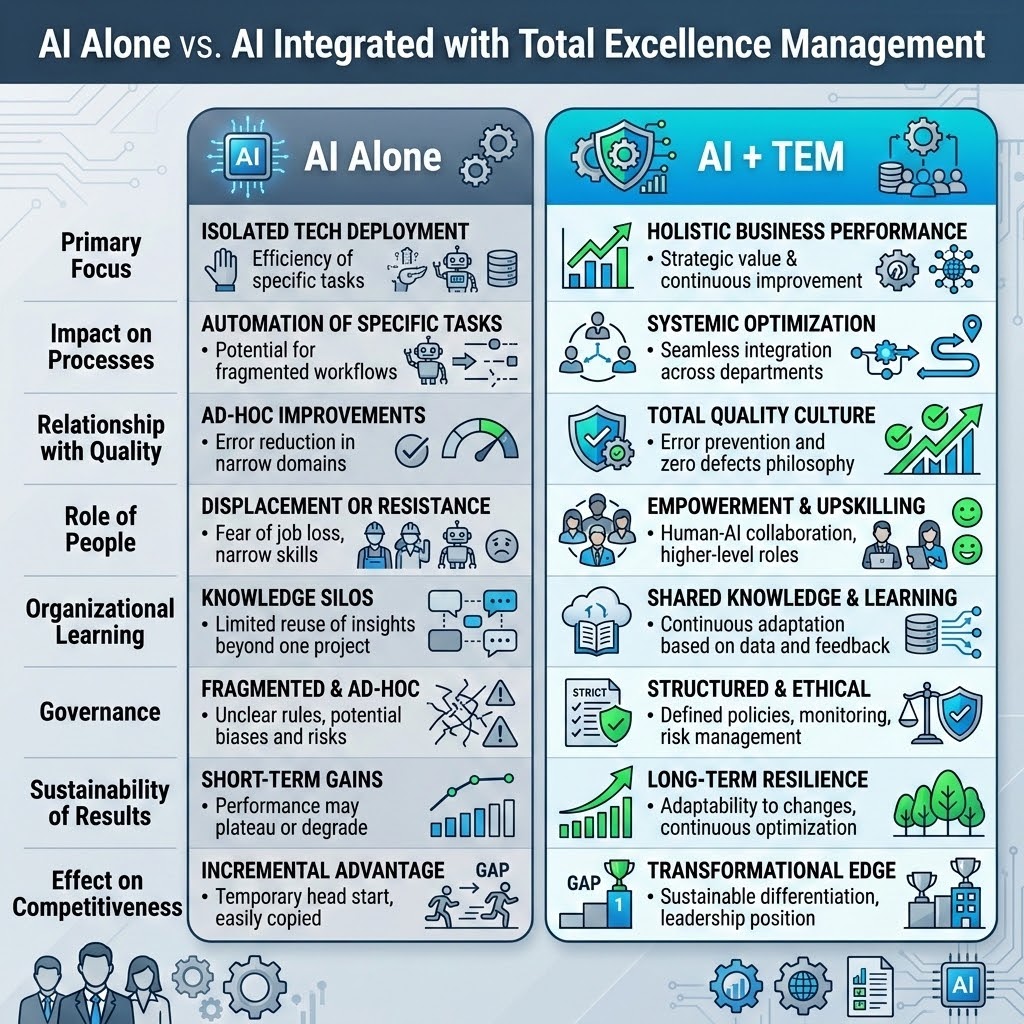
This is where Total Excellence Management (TEM) proves decisive. When AI is embedded within a culture defined by customer focus, continuous improvement, learning, trust, process discipline, and responsible leadership, it transcends being a mere digital tool to become a genuine lever for competitive advantage.
In short: AI amplifies capability. TEM provides direction.
And companies that intelligently combine the two tend to learn faster, innovate more effectively, and compete with greater resilience.
If this topic is strategic for you as well, it’s worth a conversation.
This article examines the convergence between Artificial Intelligence (AI) and Total Excellence Management (TEM), arguing that their integration constitutes one of the most promising managerial architectures for organizations seeking superior performance, resilience, continuous innovation, and sustainable competitive advantage. It contends that, although AI offers significant capabilities in automation, analytics, forecasting, and decision support, its organizational value tends to remain limited when implemented outside a management system oriented toward quality, human development, process discipline, continuous learning, and genuine customer focus. From this perspective, TEM provides the cultural and strategic foundation capable of transforming AI from a technological tool into a high-impact organizational capability. Recent evidence suggests that most organizations still remain in experimentation or pilot stages in AI, and that value creation at scale depends, among other factors, on workflow redesign, leadership engagement, and the integration of technology with human judgment. The article concludes that the combination of AI and TEM can enable companies to move beyond isolated operational gains and consolidate a model of intelligent, resilient, and long-term excellence. [mckinsey.com]
Keywords
Artificial Intelligence; Total Excellence Management; operational excellence; resilient leadership; continuous improvement; AI governance; organizational transformation.
Introduction
In a business environment marked by rising volatility, technological acceleration, performance pressure, and continuous demand for innovation, Artificial Intelligence has assumed a central position in contemporary strategic agendas. Its ability to process large volumes of data, support decisions, automate tasks, and enhance productivity has frequently been presented as a decisive lever for business transformation. Even so, the diffusion of AI across organizations does not automatically translate into sustainable value.
McKinsey’s global survey, published on November 5, 2025, indicates that 88% of respondents say their organizations regularly use AI in at least one business function, yet only about one-third report having reached the scaling phase across the organization; in addition, nearly two-thirds still remain in experimentation or pilot stages. The same survey reports that 62% of organizations are at least experimenting with AI agents, and 39% report some level of EBIT impact at the enterprise level, though in most cases the impact is less than 5%. These findings suggest that the core issue lies not merely in technological adoption, but in the management philosophy under which that technology is introduced. [mckinsey.com]
It is precisely at this point that Total Excellence Management becomes relevant. More than a set of tools, TEM represents a management logic grounded in customer focus, continuous improvement, process discipline, organizational learning, people development, and sustainable value creation. From this standpoint, AI should not be understood as a self-sufficient solution, but as a capability that becomes substantially more valuable when embedded in a management system consistent with excellence.
The Deming tradition reinforces this understanding. The W. Edwards Deming Institute presents the System of Profound Knowledge as a comprehensive theory of management and describes the PDSA cycle as a systematic process for learning and continual improvement. The integration of AI and TEM, therefore, does not represent a mere combination of technology and efficiency, but a possibility for reorganizing the very logic of performance, quality, and business resilience. [deming.org]
Discussion
Artificial Intelligence and TEM: technological capability and managerial direction
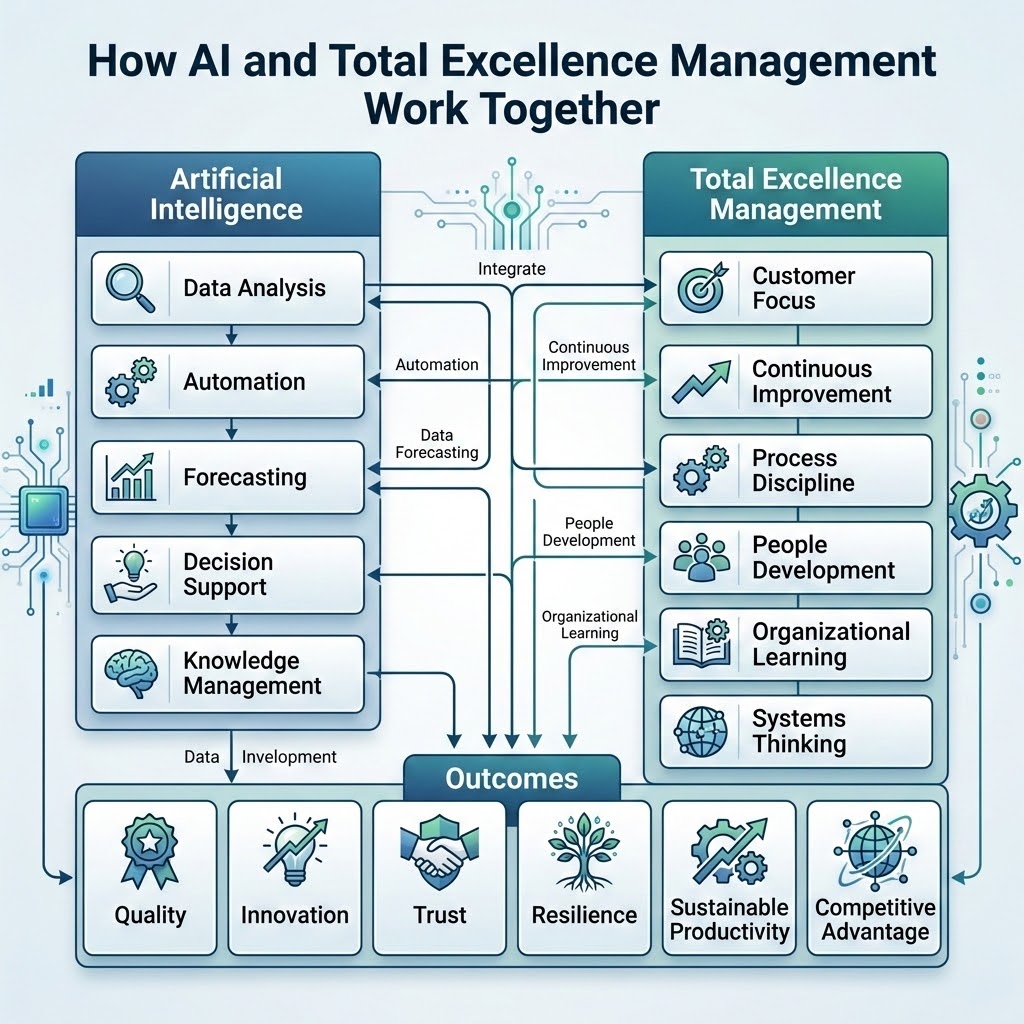
Artificial Intelligence offers highly relevant contributions to contemporary businesses. These include expanded analytical capacity, pattern identification, forecasting support, automation of repetitive activities, language processing, and support for knowledge management. Yet such contributions do not necessarily result in consistent organizational transformation.
McKinsey itself notes that while AI use is expanding, most organizations have not yet redesigned workflows and processes deeply enough to capture material business value at scale. For this reason, the challenge lies not only in the available technology, but in the absence of a managerial architecture capable of directing its application. [mckinsey.com]
Total Excellence Management addresses this gap precisely. By emphasizing quality, execution discipline, continuous learning, human development, and systems thinking, TEM provides the organizational context required for AI to move beyond being a merely operational tool and become part of the company’s value-creation system. In practical terms, AI expands organizational capability, while TEM provides strategic direction, cultural coherence, and durable sustainability of results.
Quality, trust, and customer value as integrating elements
One of the most common risks in digitalization processes is the assumption that speed, by itself, equals improvement. Fast processes are not necessarily excellent processes. Likewise, AI-assisted decisions are not automatically superior decisions if they are not embedded in an environment guided by clear criteria of quality, trustworthiness, and purpose.
In this sense, the integration of AI and TEM is particularly fruitful. TEM seeks to ensure that quality is built into the process rather than inspected only at the end. AI, in turn, can contribute to this objective by enhancing monitoring, deviation detection, knowledge retrieval, and decision support. When these two dimensions converge, the organization not only executes faster, but learns and improves with greater consistency.
The importance of trustworthiness is also reinforced by the main contemporary AI governance references. The NIST AI Risk Management Framework was developed to help organizations manage risks associated with AI and highlights attributes such as validity and reliability, safety, resilience, accountability and transparency, explainability and interpretability, privacy enhancement, and fairness with harmful bias managed. The framework also presents the core functions: Govern, Map, Measure, and Manage. Concurrently, the OECD AI Principles promote innovative and trustworthy AI aligned with human rights, democratic values, transparency, robustness, safety, accountability, well-being, and sustainable development, and they were updated in 2024. In a TEM environment, such principles should not be seen as isolated external requirements, but as natural extensions of a culture oriented toward responsible excellence. [nist.gov], [s3.amazonaws.com] [oecd.org], [oecd.ai]
Workflow redesign and organizational learning
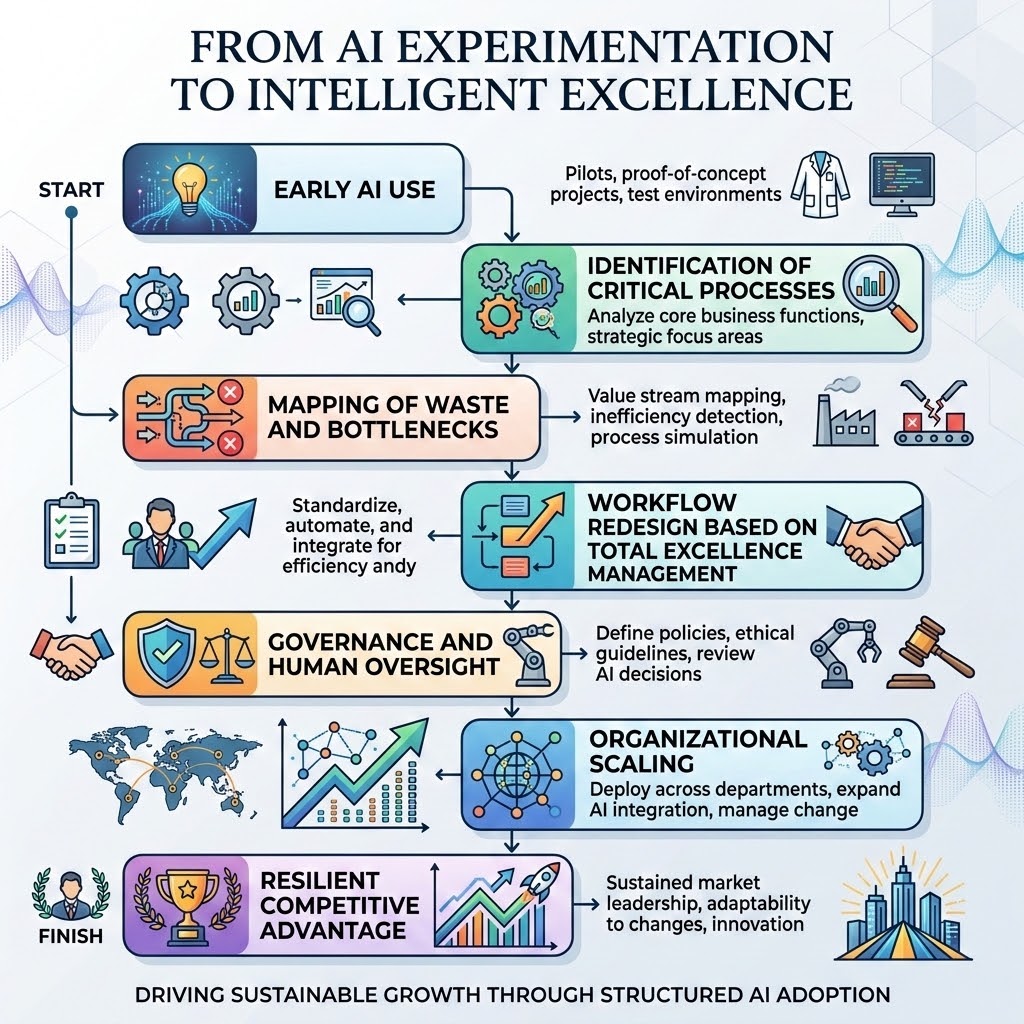
One of the most relevant findings in the contemporary discussion of AI-driven value creation concerns workflow redesign. McKinsey’s survey indicates that AI high performers are much more likely to redesign workflows fundamentally and to use AI for business transformation rather than merely as a tool for incremental efficiency. [mckinsey.com]
This point is directly aligned with the foundations of TEM. Excellence is not established by layering tools onto dysfunctional structures. On the contrary, it requires observation of reality, understanding of the process, elimination of waste, strengthening of standards, and disciplined continuous improvement. Only then can technology truly operate as a value amplifier.
From this perspective, AI’s real potential does not lie simply in automating what already exists, but in supporting the intelligent reorganization of work. The PDSA cycle, highlighted by the Deming Institute as a systematic process for learning and continual improvement, provides an especially appropriate conceptual basis for this integration. AI can accelerate data collection, variation analysis, opportunity identification, and feedback generation; TEM ensures that these gains are converted into durable institutional learning rather than isolated responses. [deming.org]
Leadership, human oversight, and strategic resilience
Another critical distinction lies in the role of leadership. The more sophisticated the technology, the more important mature, discerning, and responsible leadership becomes. McKinsey notes that organizations achieving higher performance with AI tend to have stronger senior leadership ownership and more clearly defined processes for determining how and when model outputs require human validation. [mckinsey.com]
This finding is deeply consistent with TEM. In excellence-oriented environments, leadership is not confused with mere technical imposition or excessive control. Its function is to serve, remove barriers, develop people, support learning, and create the conditions for the system to operate with higher quality, adaptability, and commitment.
In addition, the NIST AI RMF emphasizes that trustworthy AI management requires structured governance and continuous oversight throughout the lifecycle of AI systems. The OECD principles reinforce transparency, explainability, robustness, safety, and accountability. These guidelines show that the combination of AI and TEM should not lead to the indiscriminate replacement of human judgment, but to the construction of a hybrid organizational intelligence in which technology and human discernment operate in complementarity. [nist.gov], [s3.amazonaws.com] [oecd.org], [oecd.ai]
It is precisely this complementarity that strengthens strategic resilience. Resilient companies are not merely fast; they are able to learn, adapt, preserve trust, and sustain performance under uncertainty. AI can expand speed and responsiveness. TEM ensures that this expansion occurs with cultural coherence, responsibility, and long-term value.
Conclusion
It may therefore be concluded that the convergence between Artificial Intelligence and Total Excellence Management does not represent a mere association between technology and management, but a strategic reconfiguration of how the organization learns, executes, decides, and creates value. AI offers speed, analytical capability, automation, and new possibilities for operational intelligence. TEM, in turn, provides the cultural and managerial assumptions that make these capabilities consistent, trustworthy, and sustainable over time.
Recent evidence shows that AI adoption alone does not guarantee enterprise-wide impact at scale. Value creation depends on factors such as workflow redesign, effective leadership engagement, the integration of technology with human judgment, and clear governance mechanisms. When these elements are articulated within an excellence-oriented culture, AI can cease to be merely an efficiency instrument and become a driver of resilient organizational transformation. [mckinsey.com], [nist.gov], [s3.amazonaws.com]
From this perspective, companies seeking to elevate their performance to new levels should not ask only how to implement AI, but under which management philosophy that implementation will be conducted. When guided by Total Excellence Management, Artificial Intelligence has the potential to become one of the most powerful contemporary levers for quality, innovation, learning, and sustainable competitive advantage.
References
DEMING, W. Edwards. Out of the Crisis. Cambridge, MA: MIT Press, 1986.
DEMING, W. Edwards. The New Economics for Industry, Government, Education. 2nd ed. Cambridge, MA: MIT Press, 2000.
MCKINSEY & COMPANY. The State of AI: Global Survey 2025 — Agents, Innovation, and Transformation. November 5, 2025. [mckinsey.com]
NATIONAL INSTITUTE OF STANDARDS AND TECHNOLOGY (NIST). AI Risk Management Framework. 2023. Generative AI profile released July 26, 2024. [nist.gov], [s3.amazonaws.com]
OECD. AI Principles. Updated in 2024. [oecd.org], [oecd.ai]
THE W. EDWARDS DEMING INSTITUTE. System of Profound Knowledge; PDSA Cycle; 14 Points for Management. [deming.org]