Stop Fragmented AI Projects! Learn the Step-by-Step Strategy to Coordinate, Scale, and Democratize AI Across Your Entire Organization
Prof. Aécio D’Silva, Ph.D
AquaUniversity
Your AI Projects Are Failing to Scale. Here’s Why.
AI-CTE – Your company is investing heavily in Artificial Intelligence—pilots are launching, data scientists are busy, and excitement is high. Yet, you notice a troubling pattern: solutions developed in one department don’t help another, standards are inconsistent, and projects often stall before they deliver real, company-wide value. You are suffering from Fragmented AI Syndrome. The antidote isn’t more software; it’s a dedicated, centralized leadership structure: the AI Center of Total Excellence Leadership-Management (AI-CTE). This isn’t just an IT department—it’s the strategic engine that ensures every AI initiative drives maximum value, ethical integrity, and total excellence across your business.
Briefing: The Strategic Mandate for Centralized AI Leadership – AI-CTE
In the age of machine learning, AI must be treated as a strategic asset, not a collection of isolated tools. Without a central body like an AI-CTE, businesses risk wasting millions on duplicated efforts, exposing themselves to ethical and compliance risks, and missing out on exponential growth opportunities. The AI-CTE acts as the single source of truth and the catalyst for excellence, ensuring AI adoption is coordinated, democratized, and value-driven from the boardroom to the production floor.
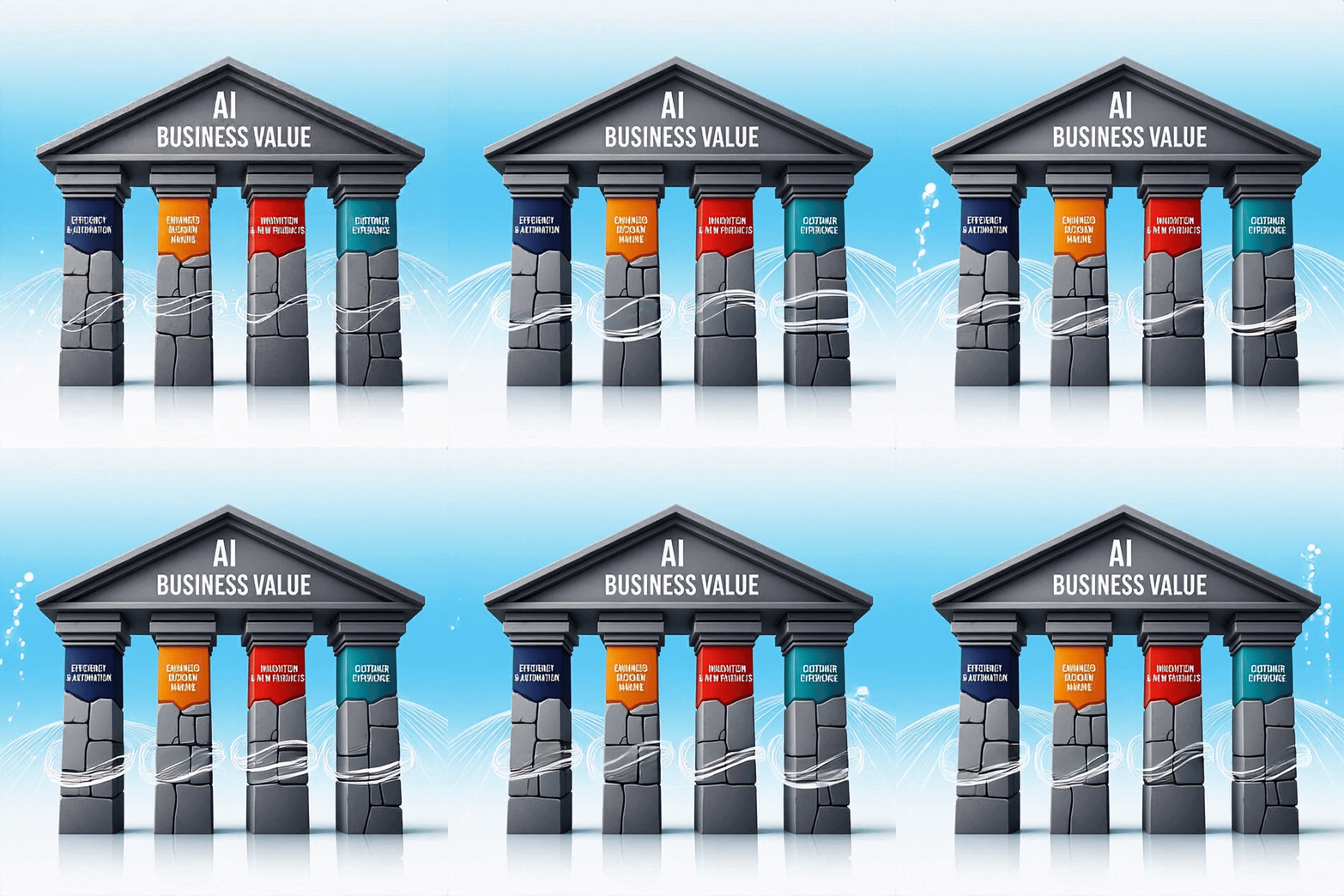
What You’ll Learn in This Blog:
- The critical strategic importance of centralizing AI leadership.
- The step-by-step process for establishing an AI AI-CTE.
- How the AI-CTE drives value, ensures ethical implementation, and scales AI effectively.
- How to democratize AI by making tools and expertise accessible to every employee.
- Real-world examples of similar excellence centers established by major enterprises.
-
Why Fragmented AI is a Business Killer
In many companies, AI adoption happens organically: a marketing team builds a prediction model, while a separate operations team optimizes logistics with another tool. This siloed approach leads to disaster:
- Duplication of Effort: Different teams spend time and money building the same foundational models or data pipelines.
- Inconsistent Standards: Models lack standardization, making them difficult to audit, update, or share.
- Ethical and Compliance Risks: Without central oversight, models may unintentionally embed bias or violate privacy regulations, leading to major legal and reputational damage.
- Failure to Scale: Successful pilots remain trapped in small teams because there is no mechanism to scale them across the entire enterprise.
The AI-CTE resolves these issues by replacing chaos with a coordinated, enterprise-wide strategy.
-
The Strategic Importance of the AI-CTE
The AI-CTE is not merely a cost center; it is a Profit and Excellence Center. Its strategic value lies in its ability to enforce consistency and maximize return on investment (ROI):
- Value Realization: It prioritizes projects with the highest strategic value, ensuring AI efforts align directly with key business objectives (e.g., revenue growth, cost reduction, customer satisfaction).
- Risk Mitigation: The AI-CTE establishes and enforces mandatory ethical AI guidelines and governance frameworks, drastically reducing legal and compliance risks.
- Talent Development: It becomes the hub for all AI expertise, standardizing training, fostering a community of practice, and attracting and retaining top AI talent.
- Innovation Velocity: By providing standardized tools and reliable data infrastructure, the AI-CTE removes roadblocks, allowing local teams to build and deploy solutions faster.
-
Step-by-Step: Establishing Your AI-CTE
Launching an AI-CTE requires a structured, multi-phase approach:
Phase I: Design and Mandate
- Secure Executive Buy-In: The AI-CTE must be sponsored by the CEO, COO, or CIO. Its mandate must be clear: to coordinate all AI efforts company-wide.
- Define Mission and Scope: Determine what the AI-CTE will own (e.g., ethical guidelines, core platforms, talent development) and what local teams will own (e.g., specific business use cases, model fine-tuning).
- Appoint Leadership: Hire an experienced leader (often called the Chief AI Officer or Head of AI Excellence) with both technical depth and executive management skills.
- Initial Team Formation: Recruit a small, high-impact team focused on governance, platform architecture, and ethical standards.
Phase II: Platform and Governance
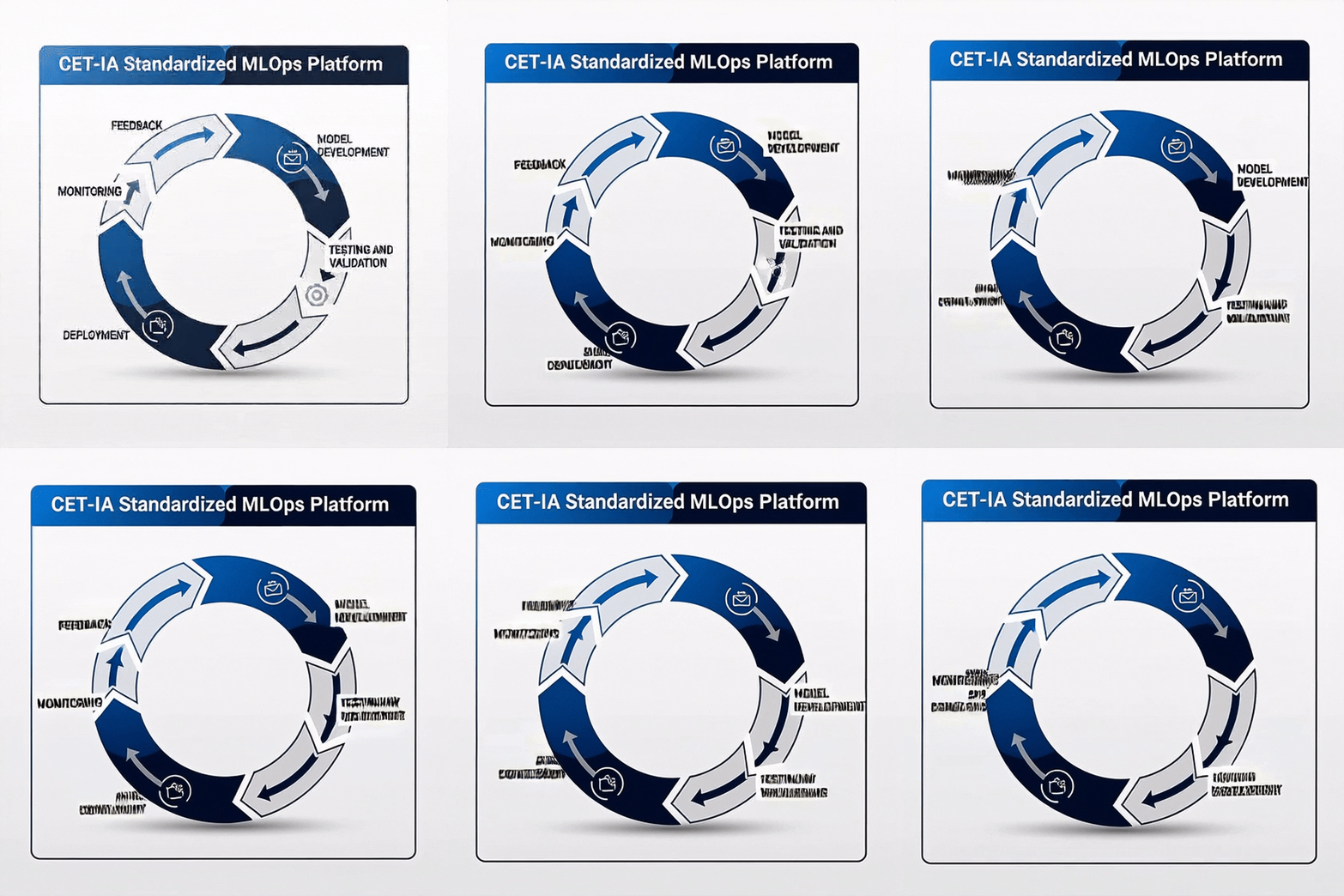
- Standardize the Tech Stack: Select and implement a single, unified platform for Machine Learning Operations (MLOps). This provides the “assembly line” for building, deploying, and monitoring all models.
- Develop Governance Frameworks: Create non-negotiable policies for data privacy, model bias testing, and model documentation. This is your insurance policy against major ethical blunders.
- Centralize Data Access: Work with IT to establish a centralized, high-quality data lake or data warehouse, making the data needed for AI easily accessible to authorized teams.
Phase III: Democratization and Scale
- Launch the AI Academy (Democratization): Offer training programs to non-AI staff (business analysts, managers) to help them understand AI’s potential and identify use cases. The goal is to make AI concepts accessible to every collaborator.
- Establish a Community of Practice: Create forums, newsletters, and internal hackathons where engineers and business leaders can share successes, failures, and best practices.
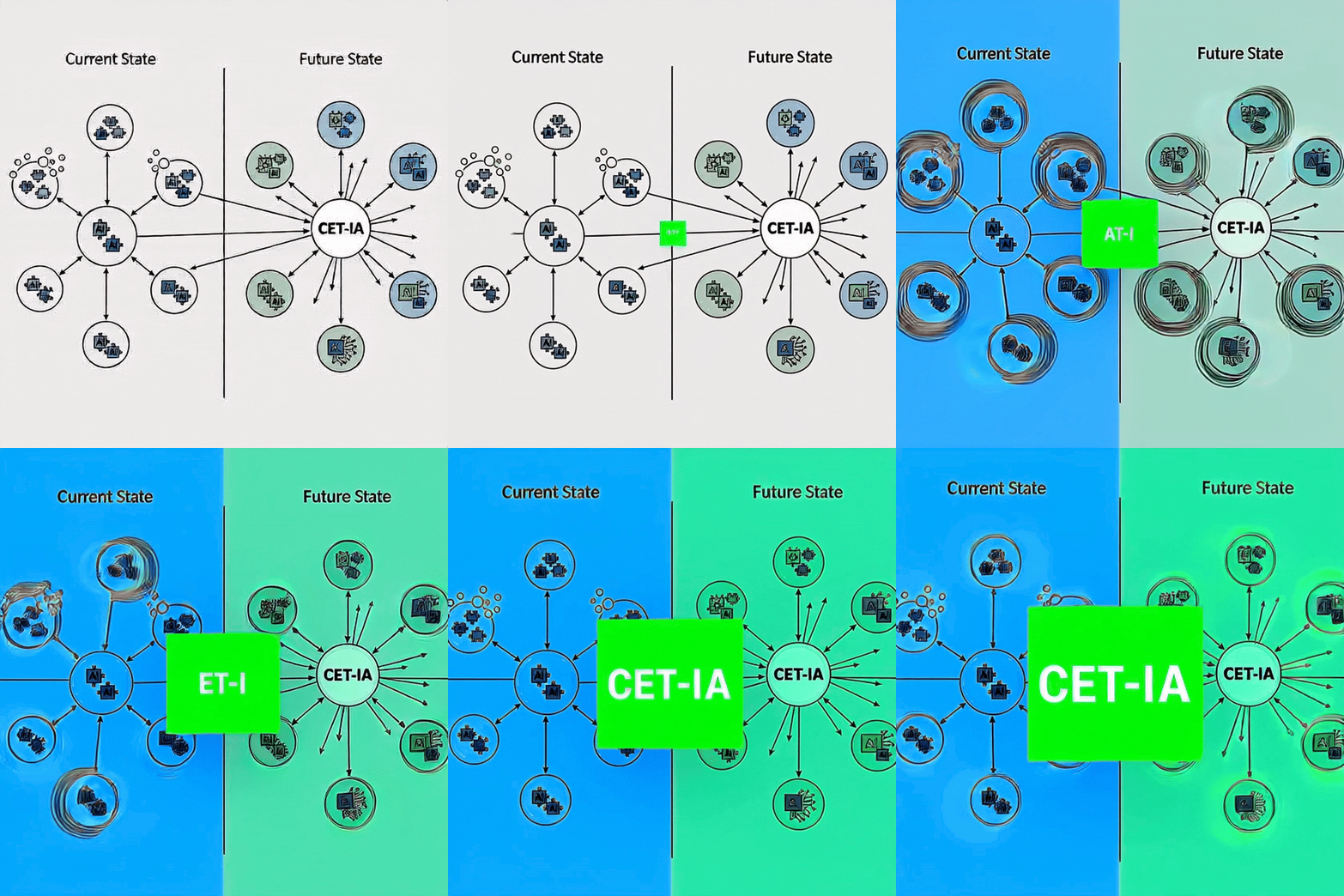
- Roll Out Reusable Assets: The AI-CTE builds core, common components (e.g., generalized customer churn models, standard natural language processing libraries) that local teams can simply plug into their projects, accelerating development time by up to 50%.
- Measure and Communicate Value: Continuously track the ROI of all coordinated AI projects and communicate these successes back to the executive sponsors to justify continued investment.
-
AI-CTE as a Catalyst for Excellence and Democratization
The concept of a “Center of Excellence” has been successfully used by major firms in fields like Lean Manufacturing (Toyota) and Six Sigma (Motorola). In the AI context, this excellence is achieved through democratization:
- Citizen Data Scientist Enablement: The AI-CTE provides low-code/no-code tools (e.g., automated machine learning platforms) that empower business analysts to build simple models without needing a PhD in computer science.
- Knowledge Transfer: Through standardized training, the AI-CTE ensures that the company’s collective AI knowledge doesn’t reside only in one small, elite team but is distributed across departments.
- Fostering a Culture of Experimentation: By providing a safe, controlled MLOps environment, the AI-CTE encourages local teams to experiment quickly, fail fast, and scale proven concepts instantly. This embeds AI into the company’s DNA.
-
AI-CTE Models in the Real World
Many major enterprises have effectively implemented similar structures to coordinate their data and AI strategy:
| Company (or Industry Model) | Focus Area of Center | Core Function |
| Microsoft | Data & AI Center of Excellence | Provides central architecture, governance, and reusable AI components for business units worldwide. |
| Large Banks (e.g., JPMorgan Chase) | Data Science & Machine Learning CTE | Focuses heavily on risk modeling, regulatory compliance, and validating the ethical use of AI models in lending. |
| Retail Giants (e.g., Walmart) | Technology Innovation Hubs | Combines talent development, experimentation, and platform standardization to rapidly deploy retail-specific AI solutions (e.g., inventory tracking). |
Export to Sheets
These examples show that a centralized, excellence-focused approach is the standard for organizations aiming for industrial-scale AI deployment.
Final Thoughts Conclusion
The transition to an AI-powered business cannot be left to chance or isolated teams. Establishing an AI Center of Total Excellence Leadership-Management (AI-CTE) is the single most critical strategic move a company can make to ensure its AI investments pay off. By centralizing governance, standardizing the MLOps platform, and actively democratizing knowledge, the AI-CTE transforms AI from a siloed experiment into a coordinated, ethical, and scalable engine for total organizational excellence. The question is no longer if you need an AI-CTE, but how quickly you can establish yours to secure a competitive advantage in the AI era.
Glossary of Essential Words/Terms
| Term | Definition |
| AI CTE | AI Center of Total Excellence Leadership-Management. A dedicated, centralized unit responsible for coordinating, governing, scaling, and democratizing all AI initiatives across an enterprise. |
| Fragmented AI Syndrome | The problem where AI projects are developed in isolated silos across a company, leading to duplicated efforts, inconsistent standards, and failure to scale. |
| MLOps | Machine Learning Operations. A set of practices that automates and standardizes the process of building, deploying, monitoring, and managing machine learning models in production environments. |
| Democratization of AI | The process of making AI tools, models, and knowledge accessible and usable by non-expert employees (e.g., business analysts, managers) throughout the organization. |
| Citizen Data Scientist | A business professional who can build or generate models using low-code/no-code platforms provided by the AI-CTE, without having a formal background in data science. |
| Governance Framework | The set of policies, rules, roles, and procedures established by the AI-CTE to ensure AI models are developed ethically, comply with regulations, and meet technical standards. |
| Reusable Assets | Core algorithms, data pipelines, or code libraries built by the AI-CTE that can be instantly reused by multiple project teams, speeding up development. |
| Chief AI Officer (CAIO) | The executive leader often responsible for overseeing the AI-CTE and setting the company’s overall AI strategy. |
AI CTE Knowledge Check: 10-Question Quiz
- What is the primary problem the AI-CTE is designed to solve?
- A. Lack of budget for new software.
- B. Fragmented AI Syndrome and siloed efforts.
- C. Too many employees want to learn AI.
- D. Slow internet speeds.
- The term “MLOps” primarily refers to:
- A. Training new data scientists.
- B. Standardizing and automating the deployment and management of models.
- C. Writing business reports on AI usage.
- D. Hiring specialized programmers.
- In which phase is the AI-CTE’s mission and scope formally defined?
- A. Phase III: Democratization and Scale.
- B. Phase II: Platform and Governance.
- C. Phase I: Design and Mandate.
- D. Phase IV: Full Deployment.
- What is a key function of the AI-CTE regarding risk mitigation?
- A. Avoiding all AI projects.
- B. Outsourcing all ethical decisions.
- C. Establishing mandatory ethical AI guidelines and governance.
- D. Buying more cybersecurity software.
- What concept is the AI-CTE attempting to achieve by providing low-code tools to non-AI staff?
- A. Outsourcing labor.
- B. Democratization of AI.
- C. Intellectual property lockdown.
- D. Centralizing all coding work.
- Which executive role is typically responsible for sponsoring the AI-CTE?
- A. Chief Marketing Officer (CMO).
- B. CEO, COO, or CIO.
- C. Head of Human Resources (HR).
- D. Vice President of Sales.
- A key benefit of the AI-CTE building “Reusable Assets” is:
- A. Making training materials easier to print.
- B. Accelerating project development time by providing pre-built components.
- C. Reducing the need for physical office space.
- D. Simplifying the annual audit process.
- The AI-CTE’s role in “Value Realization” involves:
- A. Cutting the salaries of data scientists.
- B. Prioritizing AI projects with the highest strategic business value.
- C. Only working on easy projects.
- D. Purchasing the cheapest available software.
- Why is centralizing data access important for the AI-CTE?
- A. To ensure only one person can see the data.
- B. To make the AI-CTE’s office look better.
- C. To ensure all AI projects have access to high-quality, standardized data.
- D. To reduce the time spent in meetings.
- The AI-CTE helps foster a “Community of Practice” mainly to:
- A. Charge for internal consulting services.
- B. Share successes, failures, and best practices across departments.
- C. Limit communication to only the most senior staff.
- D. Create a standardized company dress code.
Click here to check the correct answers
References
- Valentine, M., Politzer, D. J., & Davenport, T. H. (2025, September 18). How to Make Enterprise Gen AI Work. Harvard Business Review. https://hbr.org/2025/09/how-to-make-enterprise-gen-ai-work
- Westerman, G., & Cotteleer, M. (2020). Digital Transformation Strategies: Why AI Needs a Center of Excellence. MIT Sloan Management Review.
- Derr, B. (2021). Building and Scaling AI/ML Platforms: Lessons Learned. O’Reilly Media. (Focuses on the MLOps component).
- IBM Institute for Business Value. (2022). AI Governance: The Ultimate Guide. (Provides frameworks for ethical and risk mitigation).