From Data Overload to Actionable Insights – How These Supercharged Facilities Are Powering the AI Revolution with Renewable
Prof. Aécio D’Silva, Ph.D
AquaUniversity
AI Factories: Ignite Your Imagination for the Future of AI
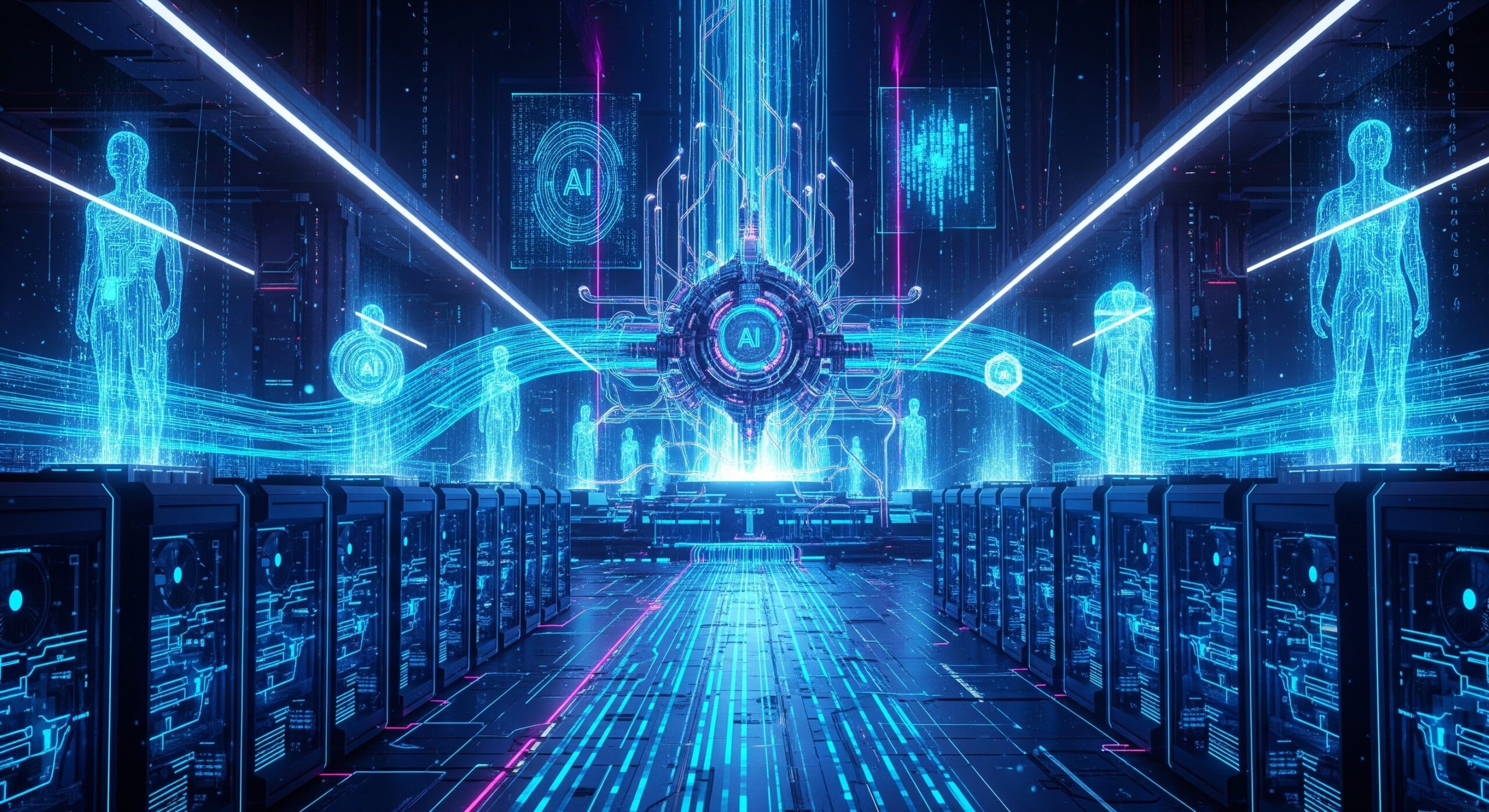
Picture a colossal, humming fortress where raw data streams in like rivers and emerges as razor-sharp intelligence—decisions, predictions, innovations that shape our world. Welcome to the AI factory, NVIDIA’s game-changing invention that’s turning sci-fi into reality. These aren’t your grandpa’s data centers; they’re high-octane powerhouses optimized for the relentless demands of AI, churning out models that drive everything from self-driving cars to personalized medicine. In an era where AI is the new electricity, AI factories are the generators, and with renewables like solar and wind fueling them, they’re as green as they are groundbreaking. Ready to step inside?
Briefing: Quick Overview
This comprehensive blog unlocks the world of AI factories, NVIDIA’s pioneering concept for specialized data centers that manufacture and deploy AI at unprecedented scale. Tailored for curious minds—from tech enthusiasts to business leaders—we’ll demystify how these facilities transform data into actionable intelligence through the full AI lifecycle: intense processing, model training, and high-volume inference. Discover their key characteristics, why they’re primed for renewable energy like solar and wind with storage, and how specialized infrastructure (vast GPU arrays, advanced cooling, and ultra-fast networking) sets them apart from traditional data centers. You’ll explore real-world differences in purpose, hardware, scale, and efficiency, backed by cutting-edge research. Key takeaways include step-by-step breakdowns of operations, sustainability advantages, a timeline of evolution, and practical insights for the AI-driven future. Whether you’re pondering investments or just geeking out on tech, this guide equips you to grasp how AI factories are reshaping industries, emphasizing their role as “intelligence manufacturers” for a smarter, greener tomorrow.
Summary: What You’ll Learn in This Blog
Dive into the blueprint of AI factories with practical insights and research-driven explanations. By the end, you’ll know:
– The core definition and NVIDIA’s role in popularizing AI factories.
– Key characteristics and why they’re ideal for renewable energy.
– Specialized infrastructure for GPUs, AI lifecycle optimization, compute/networking, and cooling.
– How AI factories differ from traditional data centers in purpose, hardware, networking, and scale.
– Their emphasis on “manufacturing intelligence” for real-world impact.
Plus, explore a timeline, FAQ, quizzes, and an extended glossary for deeper clarity.
What Makes an AI Factory Tick? The Birth of Intelligence Manufacturing
An AI factory is a purpose-built marvel—a modern data center engineered to scale AI from abstract ideas to real-world power. Coined and championed by NVIDIA, it’s not just storage; it’s a production line where data becomes “intelligence” through relentless computation. Unlike generic servers humming away at emails or websites, AI factories devour petabytes of data, train colossal models, and spit out inferences at lightning speed, fueling everything from chatbots to climate forecasts.
Why the hype? In a world drowning in data, AI factories bridge the gap, turning chaos into clarity. They’re the engines of the AI boom, projected to drive a $15.7 trillion economic impact by 2030. But what sets them apart? It’s their laser-focus on the AI lifecycle: ingesting raw data, refining it, training models, fine-tuning for precision, and deploying inferences for instant decisions.
NVIDIA’s Spark: From Concept to Global Standard
NVIDIA’s CEO Jensen Huang first unveiled the AI factory vision in 2024, framing it as the “new industrial revolution.” Drawing from their GPU dominance, NVIDIA envisions these facilities as sovereign AI supercomputers, where thousands of interconnected chips collaborate seamlessly. Today, giants like Microsoft and Oracle are building them, proving the model’s scalability.
Key Characteristics: Power, Precision, and Planet-Friendly Potential
AI factories aren’t just big—they’re bespoke beasts tailored for AI’s voracious appetite. At their core: massive parallel processing via GPUs, lifecycle optimization, intense compute demands, specialized networking, and cutting-edge cooling. But here’s the green twist: They’re exceptionally suited for renewables like solar and wind, paired with battery storage, due to their flexible, interruptible loads.
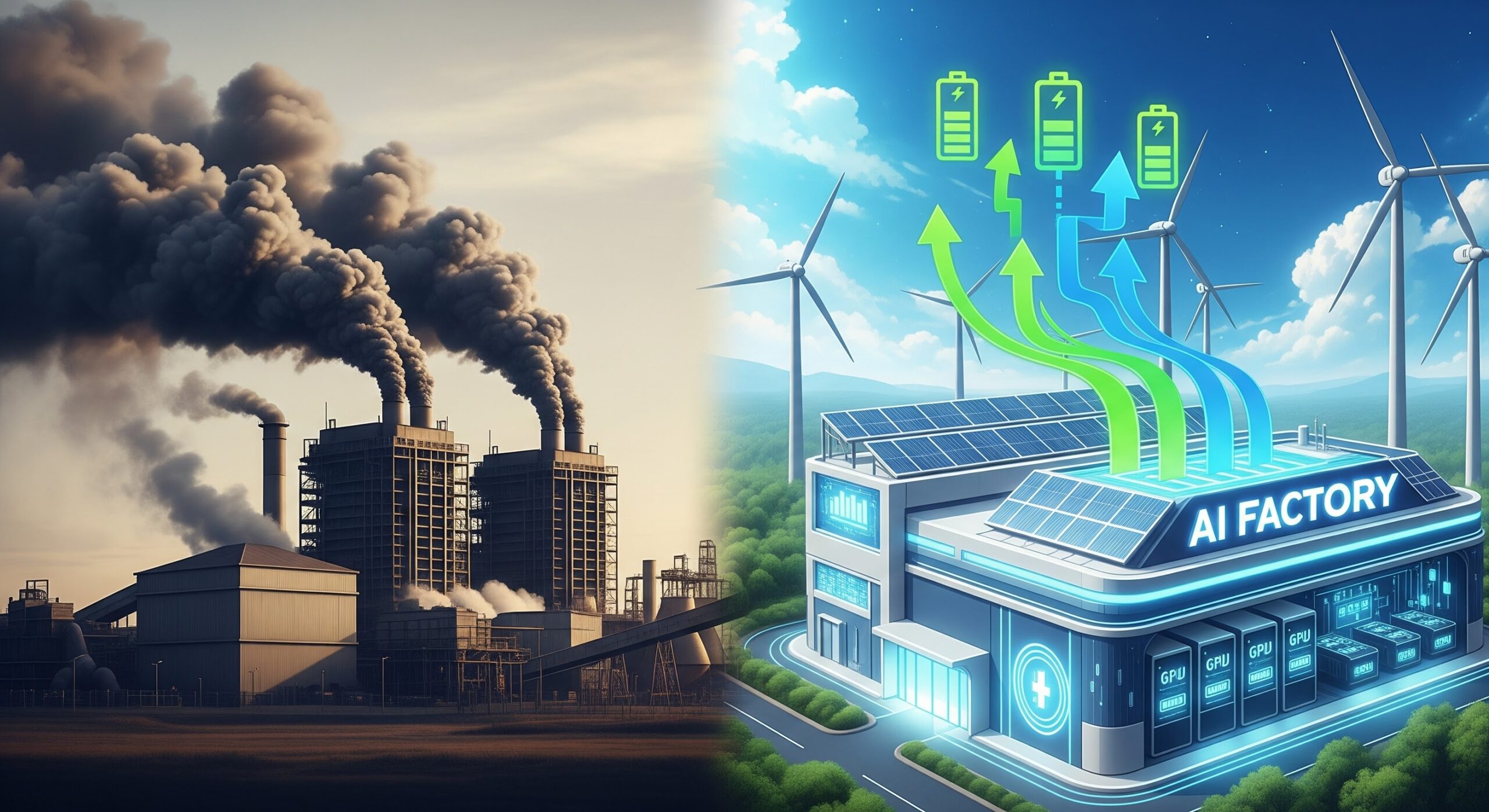
Why renewables? Traditional data centers guzzle steady power, but AI factories can throttle during low solar output, absorbing excess renewable energy when grids peak—acting as “shock absorbers” for intermittent sources. With storage (e.g., Tesla Megapacks), they store surplus wind/solar for peak AI training, slashing emissions by up to 90% compared to fossil fuels. NVIDIA’s designs even integrate direct solar ties, making AI factories not just smart, but sustainable.
AI Factories: Suitability for Renewables: A Match Made in Efficiency Heaven
AI factories’ high, variable power needs (up to 100 kW per rack) align perfectly with renewables’ intermittency. Solar peaks midday, ideal for daytime inference; wind fills nights for training. Storage buffers gaps, enabling 24/7 operation without grid strain. Case in point: NVIDIA’s partnerships with utilities show AI factories stabilizing renewables, potentially cutting global data center emissions by 20% by 2030.
Specialized Infrastructure: The Heart of the AI Beast
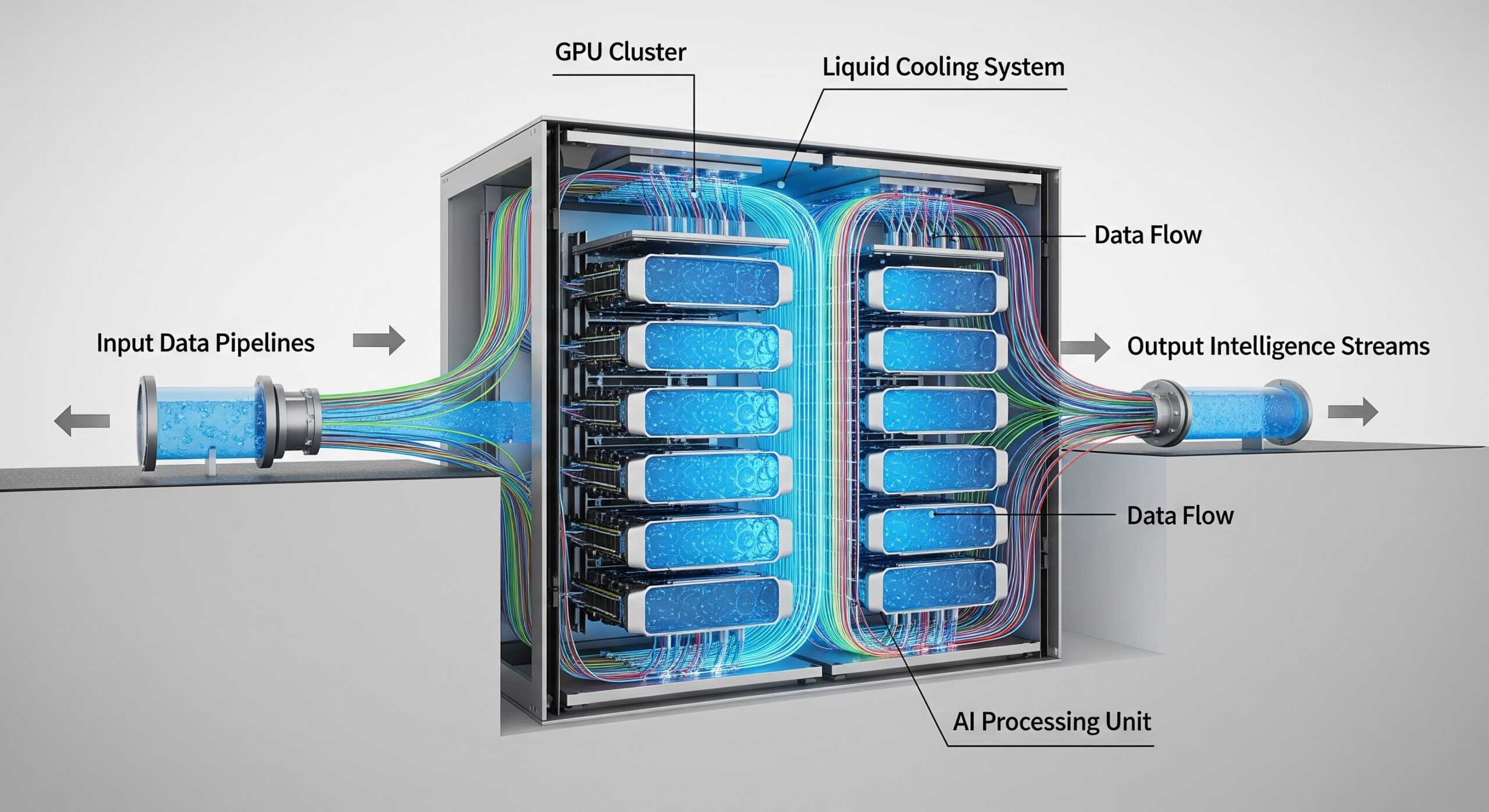
Forget one-size-fits-all servers—AI factories are GPU fortresses, housing tens of thousands of NVIDIA H100s or Blackwells for parallel crunching of trillion-parameter models. They’re wired as a unified supercomputer, with InfiniBand networking delivering 400 Gb/s bandwidth to sync computations across racks.
Cooling? Liquid immersion or direct-to-chip systems dissipate 700W+ per GPU, far beyond air-cooled norms. This setup handles the AI lifecycle end-to-end: Data ingestion cleans noisy inputs; training iterates on vast datasets; fine-tuning hones for specifics; inference scales to millions of queries.
GPUs and Parallel Power: The Compute Core
Vast GPU clusters enable the “manufacturing” ethos—processing exaflops of data to forge insights. Unlike CPUs for sequential tasks, GPUs excel at AI’s matrix math, slashing training times from weeks to hours.
Networking: The Supercomputer Glue
Flat, low-latency networks ensure GPUs act as one brain, vital for distributed training where delays kill efficiency.
Cooling Innovations: Beating the Heat Beast
AI’s thermal output demands immersion cooling, recycling heat for district warming—up to 30% more efficient than air.
Optimized for the AI Lifecycle: From Data Chaos to Insight Gold
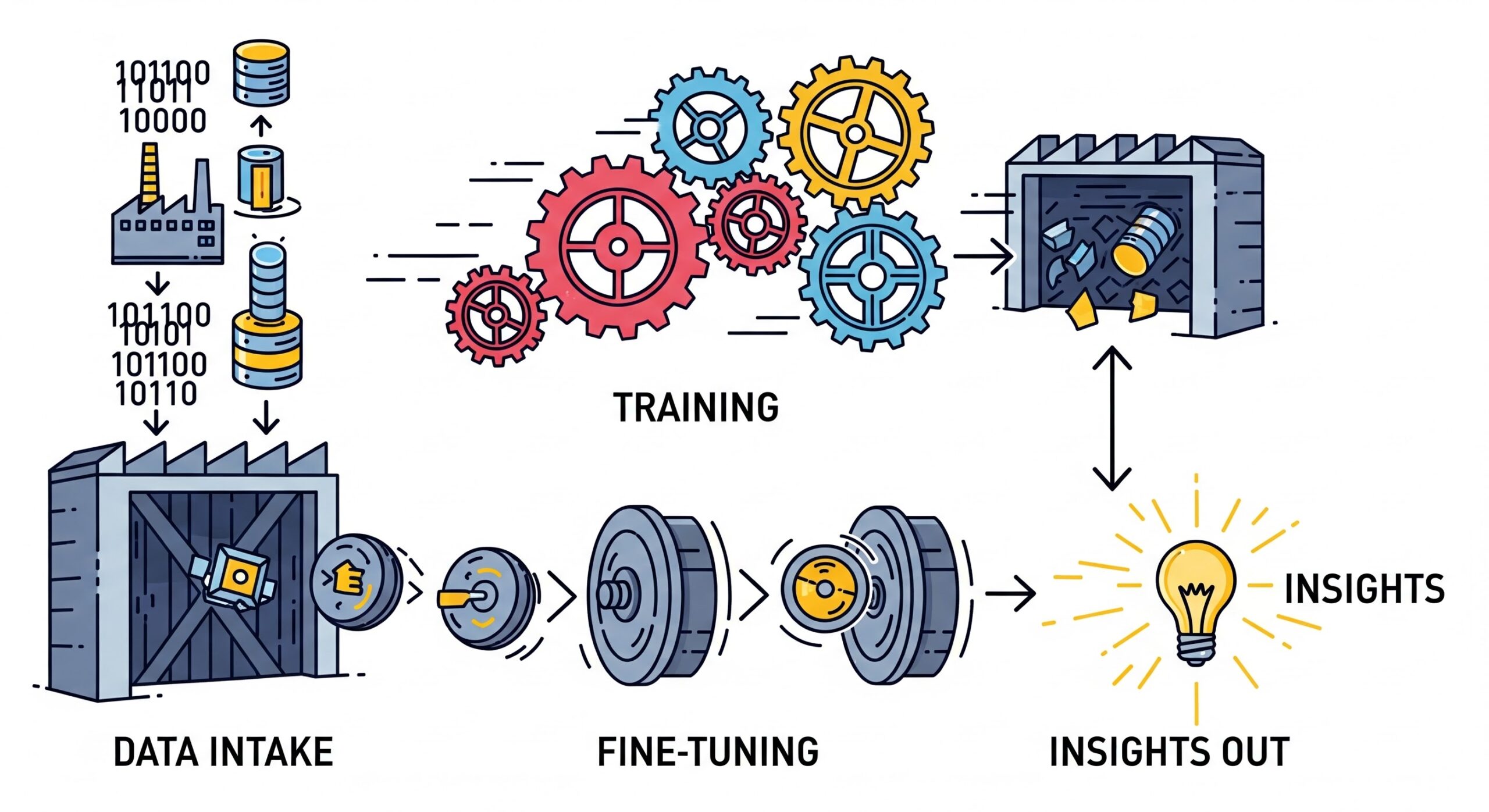
AI factories cradle every stage: Ingest vast datasets, preprocess for quality, train foundational models, fine-tune for niches, and infer at petabyte scale. This closed-loop turns “data graveyards” into intelligence pipelines, with NVIDIA’s Omniverse simulating workflows for optimization.
Manufacturing Intelligence: Beyond Storage to Creation
The magic? AI factories “manufacture” value—raw data yields predictive analytics, automated decisions, even new AI agents. It’s a paradigm shift: From passive storage to active production, democratizing AI for industries like healthcare and autonomous vehicles.
How AI Factories Outshine Traditional Data Centers
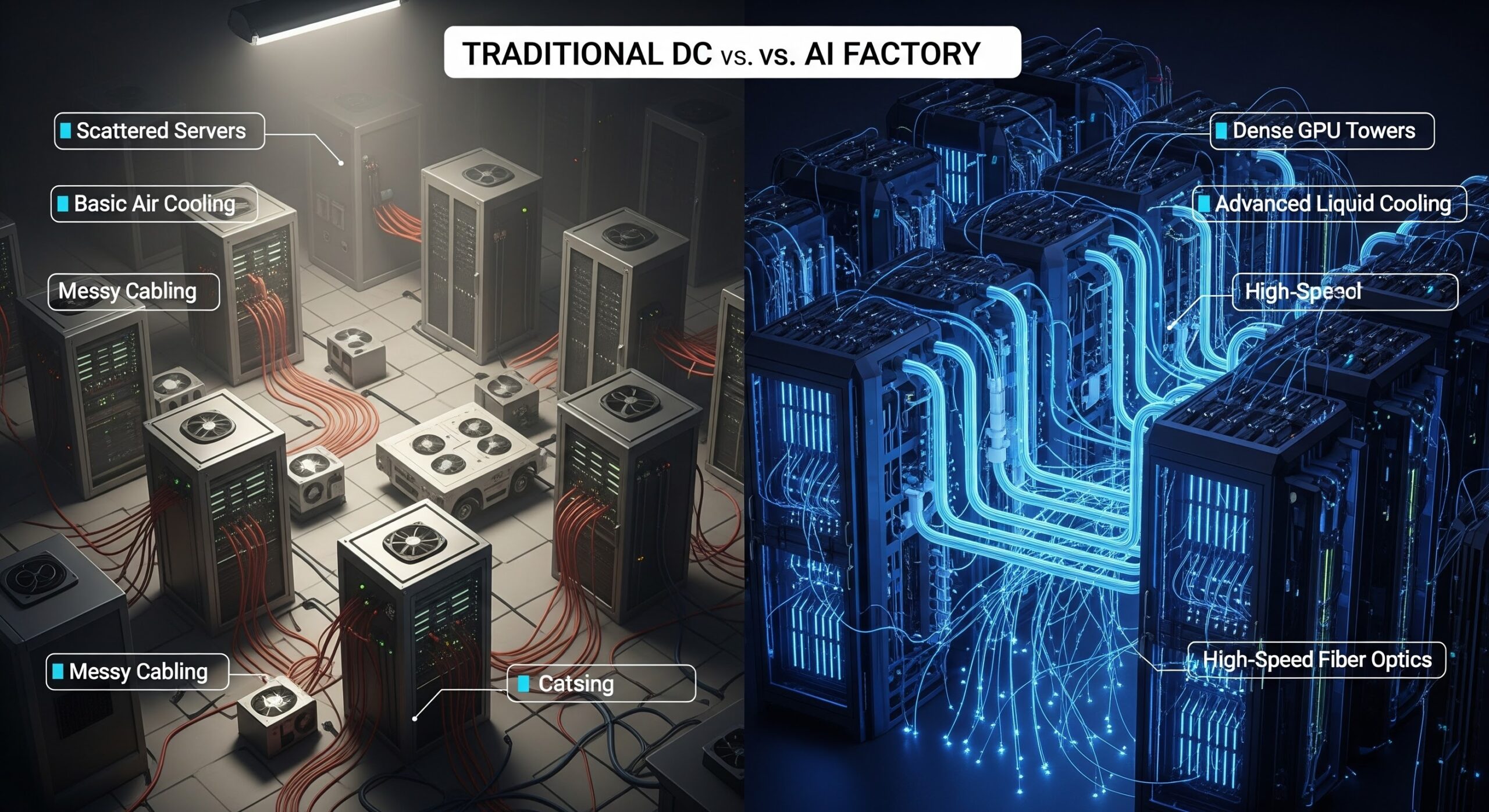
Traditional data centers? Versatile warehouses for apps and storage. AI factories? Precision AI assembly lines.
– **Purpose**: Generics host emails; AI factories forge models.
– **Hardware**: CPUs vs. GPU hordes (100x denser).
– **Networking**: Siloed vs. unified supercomputing fabrics.
– **Scale**: Modular vs. monolithic AI engines.
Why Arizona is a Magnet for AI Data Centers
Arizona’s scorching sun and vast deserts might seem unlikely for tech hubs, but surprisingly for naysayers, Arizona’s sun and business savvy make it a powerhouse for AI factories and a major hub for AI-driven data centers. Low electricity costs (among the nation’s cheapest at ~$0.07/kWh), abundant land, and top-tier fiber optic networks draw hyperscalers like Microsoft and Google. Tax incentives via the Arizona Commerce Authority shave millions off builds, while vast solar potential (over 300 sunny days/year) powers these energy hogs sustainably—NVIDIA’s Blackwell GPUs thrive here with grid-tied renewables. In 2025, Arizona is the no. 2 U.S. destination for data center growth, with 757 MW under construction—fueled by AI factories. Investments top $10B, meeting AI’s voracious power (up to 1GW per site) without coastal constraints, positioning Arizona as the “Silicon Desert.” Surprisingly
TSMC Arizona: Building the Future in the U.S.
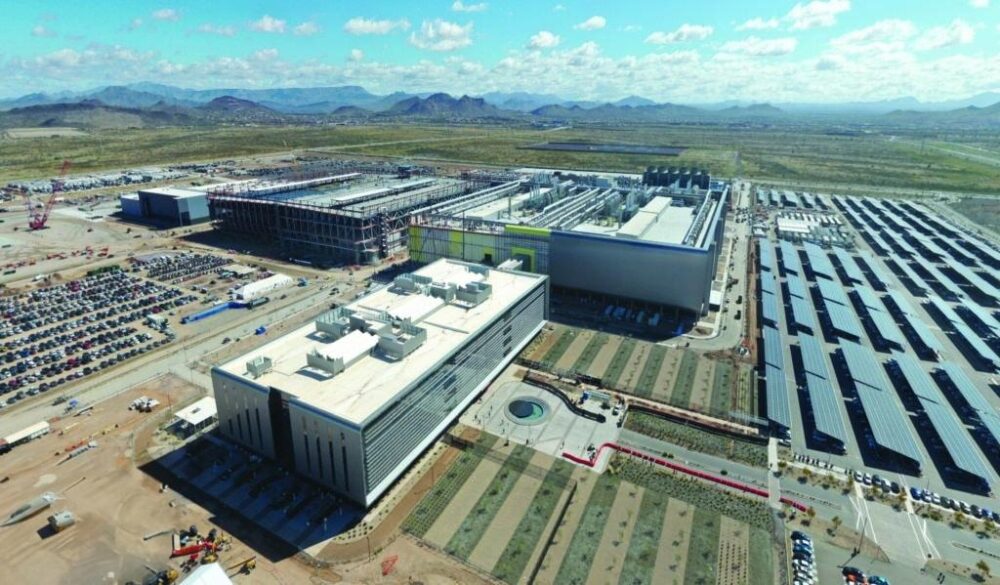
In 2020, TSMC chose Phoenix, Arizona, for its first advanced U.S. semiconductor manufacturing site — a milestone investment that has expanded from $12 billion to $165 billion – representing the largest foreign direct investment in a greenfield project in American history. Plans in Arizona include six semiconductor wafer fabs, two advanced packaging facilities, and an R&D team center. This investment will strengthen America’s leadership in critical technologies like AI, high-performance computing, and advanced mobile applications.
Final Thoughts
AI factories aren’t just buildings—they’re the forges of tomorrow, where NVIDIA’s vision turns data deluges into intelligence tsunamis. As renewables supercharge their scalability, they’re poised to make AI ubiquitous and eco-friendly. Whether you’re an innovator or investor, embracing this shift means riding the wave of progress. The factory floor awaits—will you step in?
FAQ Section
**Q: What exactly is an AI factory?**
A: A specialized data center optimized for AI production, handling the full lifecycle from data to deployment.
**Q: Why are renewables ideal for AI factories?**
A: Their flexible loads absorb intermittent solar/wind, with storage enabling 24/7 ops and grid stability.
**Q: How do AI factories differ in cooling?**
A: Liquid systems manage extreme heat from GPUs, far beyond traditional air cooling.
**Q: Can small businesses use AI factories?**
A: Cloud-based versions via NVIDIA make it accessible, scaling from startups to enterprises.
**Q: What’s the biggest challenge for AI factories?**
A: Power and heat—addressed by renewables and advanced cooling for sustainability.
Timeline: The Evolution of AI Factories
– **2012**: NVIDIA launches CUDA, enabling GPU-accelerated AI training.
– **2018**: Deep learning boom demands specialized compute; early “AI data centers” emerge.
– **2024**: NVIDIA coins “AI factory” at GTC, emphasizing intelligence manufacturing.
– **2025**: First solar-powered AI factories operational; Microsoft builds NVIDIA-based facilities.
– **2030 (Projected)**: AI factories drive 20% of global data center capacity, fully renewable-integrated.
Extended Glossary of Essential Words
– **AI Factory**: Specialized data center for scaling AI production across the lifecycle.
– **AI Lifecycle**: End-to-end process: data ingestion, training, fine-tuning, inference.
– **Cooling Systems**: Liquid immersion managing GPU heat dissipation.
– **Data Ingestion**: Initial intake and refinement of raw datasets.
– **Drum Filter**: Rotating screen removing suspended solids.
– **Fine-Tuning**: Customizing pre-trained models for specific tasks.
– **GPU (Graphics Processing Unit)**: Parallel processor core for AI compute.
– **High-Bandwidth Networking**: InfiniBand for GPU synchronization (400 Gb/s).
– **Inference**: Deploying models for real-time predictions.
– **InfiniBand**: Low-latency fabric linking AI hardware.
– **Intelligence Manufacturing**: Producing actionable AI outputs from data.
– **Liquid Cooling**: Direct fluid contact for high-heat hardware.
– **Model Training**: Iterative learning on datasets to build AI.
– **NVIDIA Blackwell**: Next-gen GPU platform for AI factories.
– **Parallel Processing**: Simultaneous computations across GPUs.
– **Rack Density**: Power per unit (30-100 kW for AI vs. 7-10 kW traditional).
– **Renewable Integration**: Solar/wind with storage for flexible loads.
Test your knowledge
1. What is an AI factory primarily designed for?
a) Storing emails
b) General cloud storage
c) Hosting websites
d) Manufacturing AI intelligence at scale
2. Why are AI factories suited for renewables like solar?
a) They use low power
b) Flexible loads absorb intermittent energy
c) They run on batteries only
d) They avoid storage needs
3. Key hardware in AI factories includes:
a) Vast GPU arrays for parallel processing
b) Basic CPUs
c) Standard hard drives
d) Simple fans
4. The AI lifecycle in factories covers:
a) Only training
**b) Data ingestion to inference
c) Just storage
d) Marketing only
5. Advanced cooling in AI factories often uses:
a) Air fans
b) Ice blocks
c) Liquid immersion systems
d) Open windows
6. How does networking differ in AI factories?
a) Slower speeds
b) Basic Ethernet
c) No connections
d) High-bandwidth for supercomputing
7. Traditional data centers focus on:
a) AI supercomputing
b) General apps like email
c) GPU density
d) Liquid cooling
8. “Manufacturing intelligence” emphasizes:
a) Generating insights from data
b) Data storage
c) Hardware sales
d) Office space
9. Rack power density in AI factories can reach:
a) 30-100+ kW
b) 5 kW
c) 1 kW
d) 200 kW
10. Renewables help AI factories by:
a) Increasing costs
b) Requiring constant fossil fuel backup
c) Enabling grid stability with storage
d) Limiting scale
Click here to get the correct answers
References
– AI Factories Are Redefining Data Centers, Enabling Next Era of AI – https://blogs.nvidia.com/blog/ai-factory/ (web:0)
– Data Center Solutions: AI Factories – NVIDIA – https://www.nvidia.com/en-us/solutions/ai-factories/ (web:1)
– Inside NVIDIA’s Vision for AI Factories: Wade Vinson’s Data Center … – https://www.datacenterfrontier.com/machine-learning/article/55286658/inside-nvidias-vision-for-ai-factories-wade-vinsons-data-center-world-2025-keynote (web:2)
– How does AI data center infrastructure differ from traditional data … – https://www.datacenterdynamics.com/en/opinions/how-does-ai-data-center-infrastructure-differ-from-traditional-data-center-workloads/ (web:3)
– AI Data Centers vs. Traditional Data Centers – 174 Power Global – https://174powerglobal.com/blog/ai-data-centers-vs-traditional-data-centers/ (web:4)
– The Rise of AI Factories: Transforming Intelligence at Scale – https://www.datacenterfrontier.com/design/article/55280489/the-rise-of-ai-factories-transforming-intelligence-at-scale (web:5)