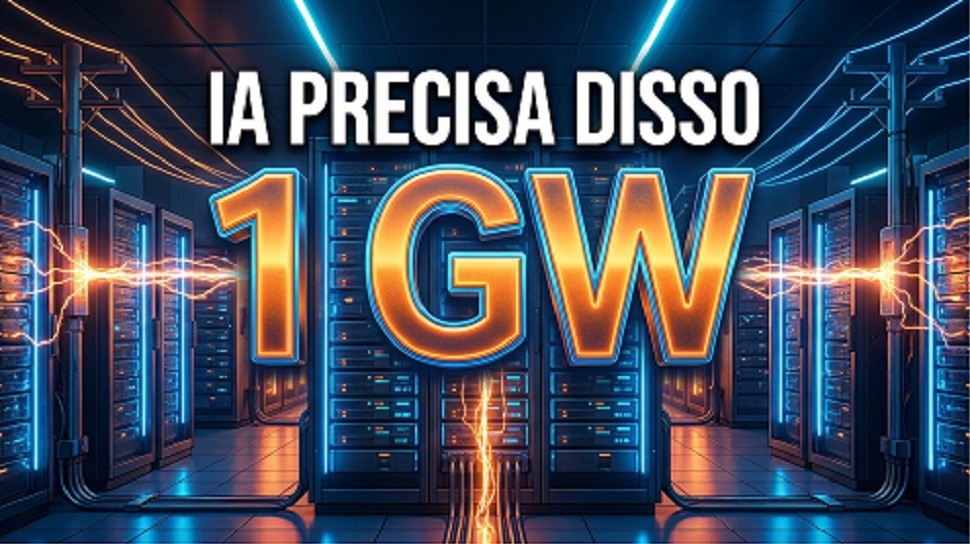
Sodium BESS (battery energy storage systems) for AI Platforms
**Prof. Aécio D’Silva, Ph.D
AquaUniversity
Keywords: BESS, battery energy storage systems, sodium batteries, sodium-ion, peak shaving, load shifting, critical digital infrastructure, AI platform, data center, energy for AI, energy storage, microgrid, demand management, energy scalability.
Summary: The rapid expansion of AI platforms and critical digital infrastructure is reshaping how electricity is procured, distributed, and safeguarded. In this environment, BESS (Battery Energy Storage Systems) built on sodium battery technology are emerging as a compelling solution for reducing demand peaks, shifting consumption to lower-cost periods, and improving operational resilience. In this article, we explain in clear terms how peak shaving and load shifting work, why sodium batteries are gaining momentum in stationary applications, how a modular architecture can start at 50 MW and scale to 1 GW with greater predictability, safety, and efficiency, and why the intelligent application of Total Excellence Management Systems (TES) is essential to sustain that growth with operational discipline and risk control.
Introduction
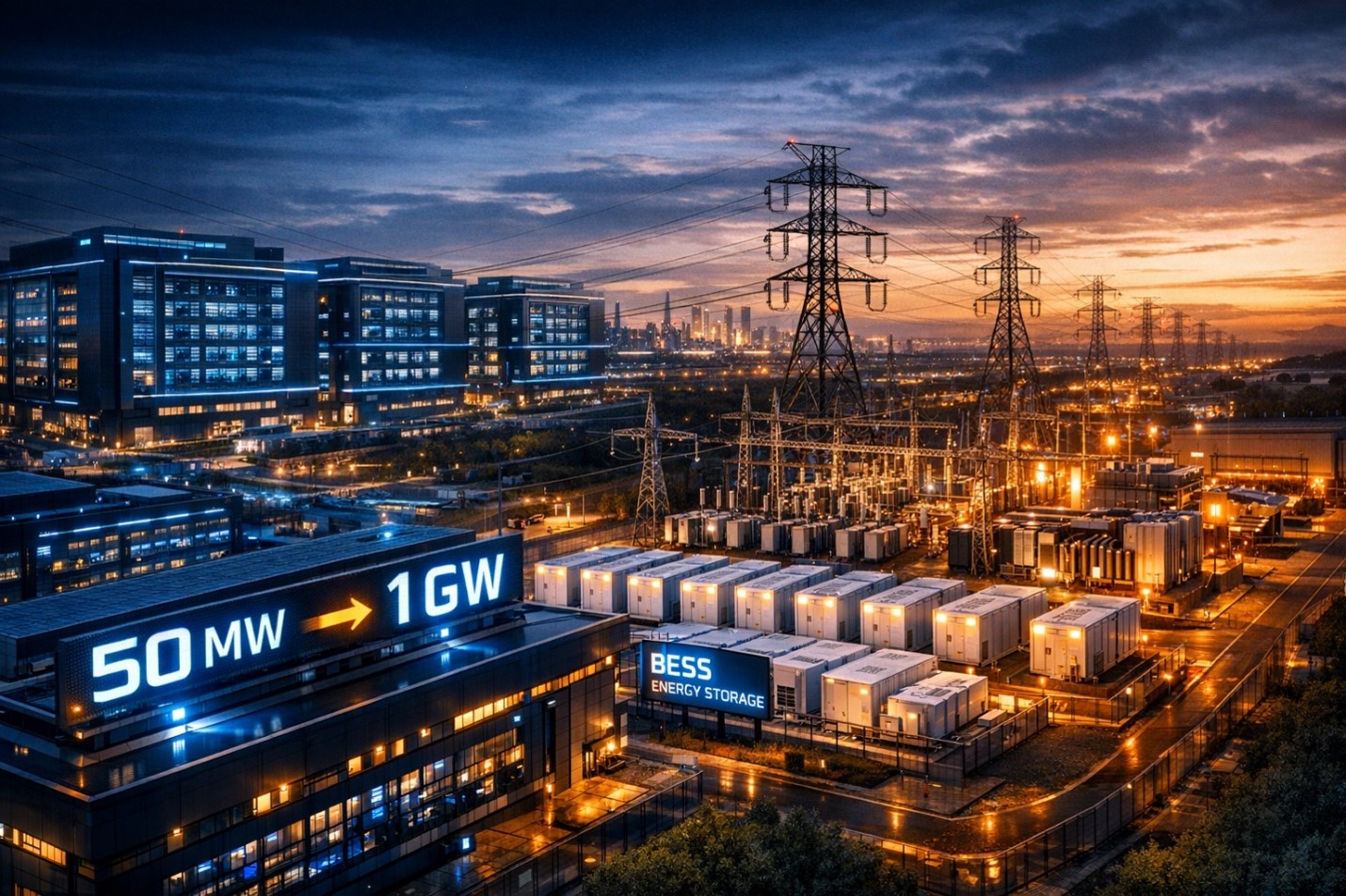
AI platforms, high-density data centers, distributed cloud environments, and other forms of critical digital infrastructure all share one requirement: reliable power that is available in real time and capable of supporting highly variable loads. As a project grows from 50 MW to hundreds of megawatts—and in some cases approaches 1 GW—the challenge is no longer simply about “having power.” The real issue becomes how to manage cost, availability, stability, and speed of expansion.
This is precisely where BESS becomes strategic. Rather than relying exclusively on the grid, backup generators, or oversized electrical infrastructure, a battery energy storage system can absorb, store, and dispatch energy according to operational needs. In AI environments, this matters because load profiles can change rapidly, putting pressure on substations, increasing demand charges, and slowing expansion in locations with limited grid interconnection. In this context, sodium battery solutions are gaining traction because of their potential to reduce system-level costs, simplify thermal management requirements, and provide greater robustness for stationary applications.
What Is a BESS and Why It Matters in Critical Infrastructure
BESS stands for Battery Energy Storage System. In practice, it is an integrated combination of batteries, power electronics, control software, safety systems, and operating logic capable of storing electricity at one moment and releasing it at another. This makes it possible to transform a rigid energy infrastructure into a much more flexible architecture.
In critical digital infrastructure, that flexibility delivers direct value across five areas: reducing demand peaks, shifting load intelligently, integrating renewable energy, strengthening operational resilience, and accelerating site electrification and expansion. Organizations running AI clusters or large digital campuses must navigate demand charges, interconnection queues, grid instability, and rising availability requirements at the same time. Energy storage helps balance these pressures without relying solely on immediate upgrades to external infrastructure.
Peak Shaving: Reducing Demand Peaks Without Compromising Operations
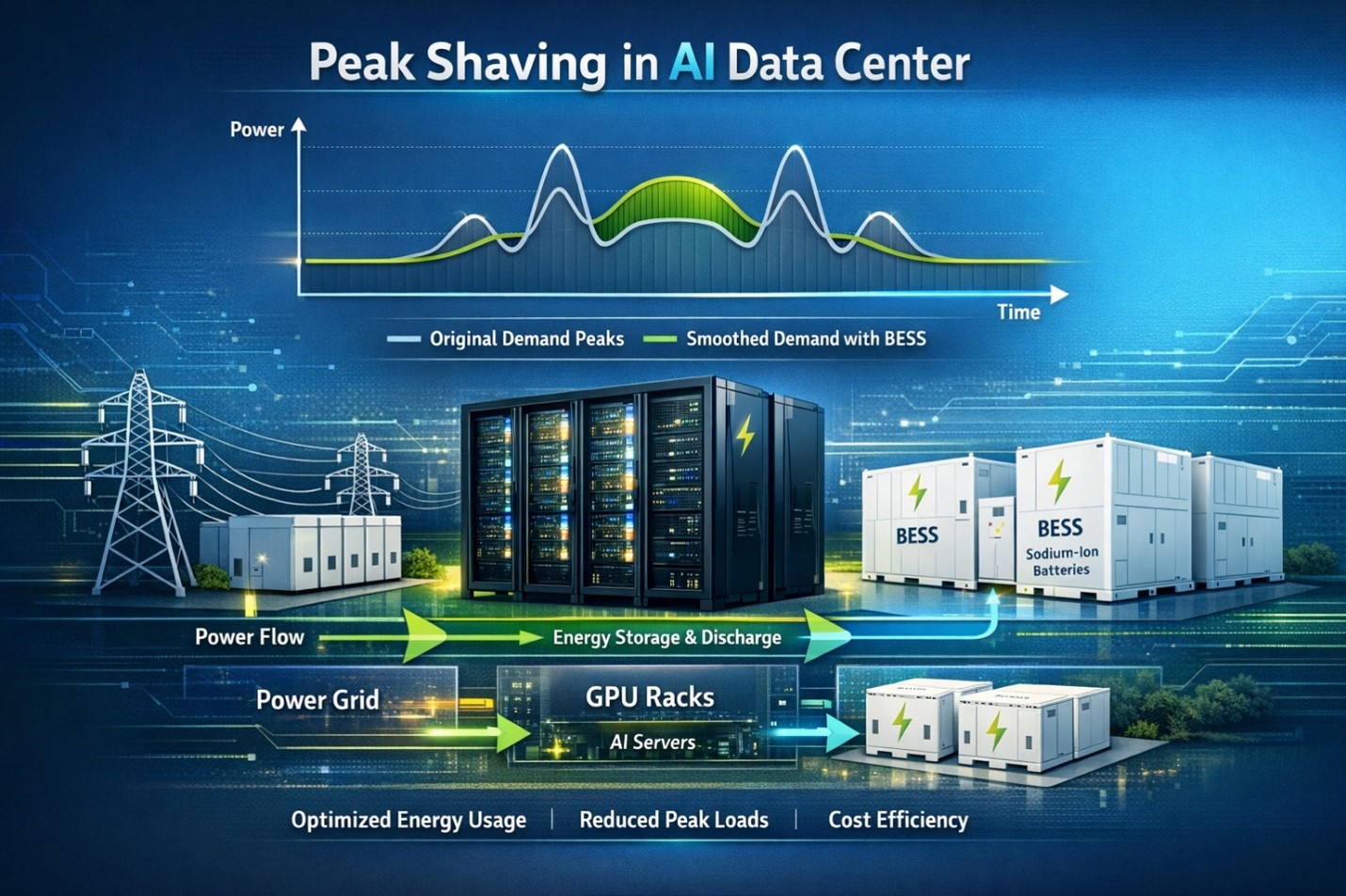
Peak shaving is the strategy of using energy stored in batteries during moments when electricity demand spikes. Instead of drawing all power directly from the grid at the moment of highest consumption, part of that need is supplied by the BESS. The result is a smoother load curve, lower peak demand contracting, and reduced costs associated with instantaneous demand spikes.
For AI platforms, this is especially important. Training, large-scale inference, and high-density workloads can create sharp ramps in electricity demand. Instead of designing the entire facility around the worst possible peak—which increases CAPEX and can delay expansion—operators can use a BESS to absorb and smooth those events. In practice, this enables a smarter growth path: begin at 50 MW, optimize existing infrastructure, and add new blocks as demand scales to 100 MW, 300 MW, 500 MW, and ultimately 1 GW. This model can also ease interconnection bottlenecks and reduce pressure on substations and cooling systems.
Load Shifting: Consuming Better, Not Just Less
Load shifting consists of storing energy during more advantageous periods and using it later, when electricity is more expensive, the grid is under greater stress, or the operation requires greater stability. In other words, the company stops being only a passive consumer and starts managing when and how it uses energy.
In AI platforms and critical digital infrastructure environments, load shifting improves operational predictability. The system can charge batteries during off-peak periods, capture surplus renewable generation, and discharge when workloads become more intensive. This reduces exposure to higher tariffs, improves energy efficiency, and creates a more stable foundation for modular expansion. From a business standpoint, the benefit is not only technical but also financial, because it aligns consumption more closely with the economics of the energy contract and the site’s available capacity.
Why Sodium Batteries Can Be an Excellent Choice for Stationary BESS
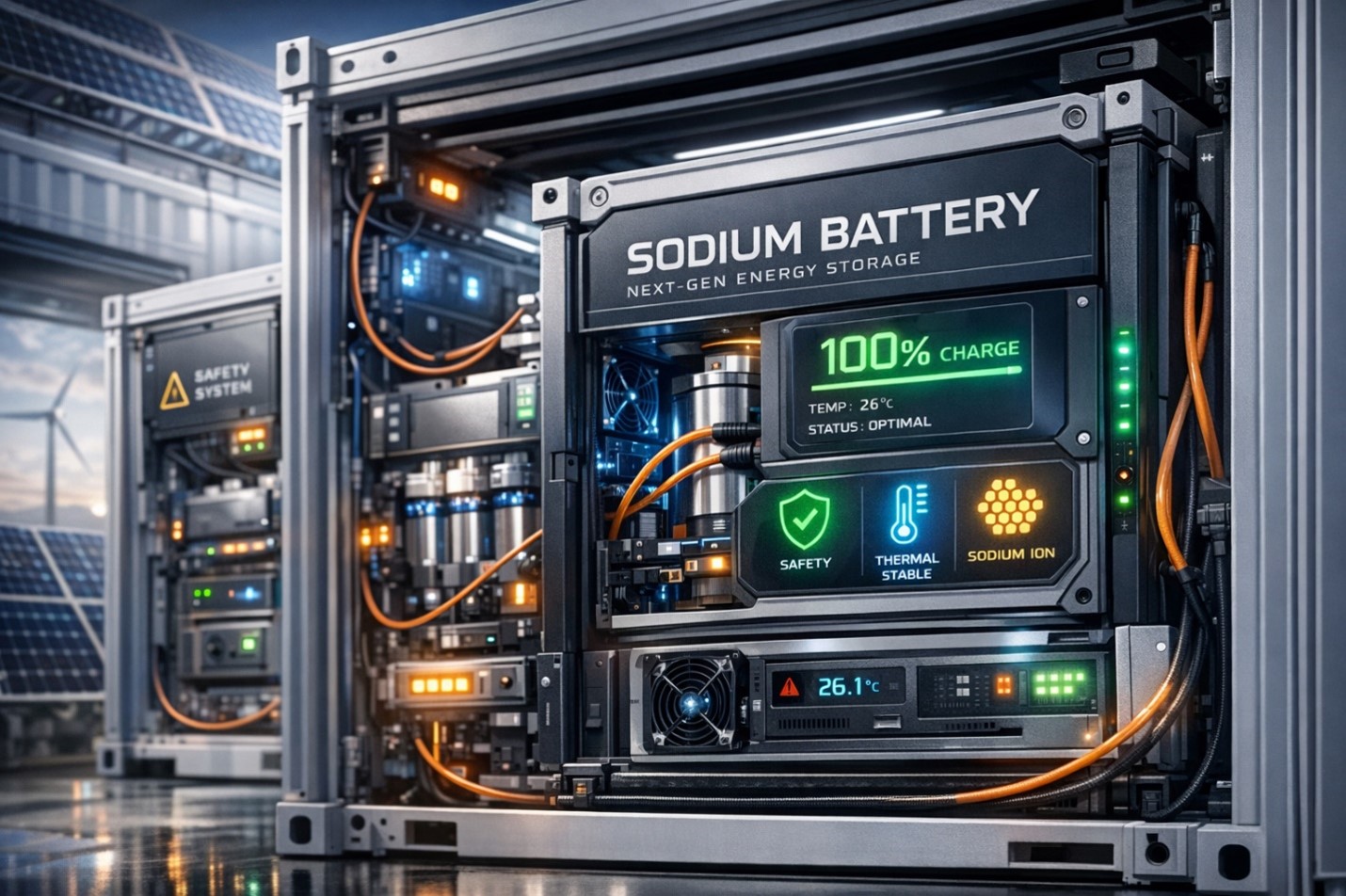
Sodium batteries operate on principles similar to lithium-ion batteries, but they use more abundant materials and are potentially less exposed to the volatility of critical supply chains. For stationary applications, this is highly relevant because the dominant criterion is not always maximum energy density, but rather safety, total cost of ownership, thermal stability, material availability, and operational durability.
Among the most frequently cited advantages for stationary use are sodium abundance, the potential for lower dependence on critical minerals, solid performance across broad temperature ranges, and, in some architectures, a reduced need for active cooling. For mission-critical environments, this can mean lower system complexity, reduced auxiliary consumption, and a more attractive operational safety profile. The main trade-off is that energy density still tends to be lower than in certain lithium chemistries, which limits its appeal in vehicles but not necessarily in stationary installations, where space and weight can be managed more flexibly.
From the First 50 MW Phase to Expansion up to 1 GW
Critical digital infrastructure projects rarely begin with 1 GW installed on day one. The most efficient path is usually modular: start with a 50 MW block, validate demand, consolidate revenue, adjust the electrical architecture, and from there repeat modules with increasing standardization. A BESS using sodium batteries can be introduced from the first phase as a strategic asset to reduce peaks, shift consumption, integrate local generation, and support expansion without always requiring the grid to be reinforced at the same speed.
When the architecture is well designed, storage stops being an isolated component and becomes part of the business’s broader energy platform. This helps shorten the time between expansion phases, improves OPEX visibility, supports smarter energy contracting, and strengthens operational resilience. In a market where electrical availability has become a competitive differentiator, the ability to move from 50 MW to 1 GW with greater risk control, stability, and efficiency can become a decisive advantage.
BESS and Total Excellence Management Systems (TES)
Another critical factor in scaling a sodium battery BESS from 50 MW to gigawatt-scale deployments is the intelligent application of Total Excellence Management Systems (TES). In AI platforms and critical digital infrastructure, TES helps unify operational governance, process standardization, performance management, reliability, safety, maintenance, and continuous improvement within a single execution framework. That discipline becomes essential at scale because it reduces variability across expansion phases, accelerates operational learning, improves the rollout of new capacity blocks, and strengthens the ability to grow with quality, predictability, and risk control.

Conclusion
The rise of AI and critical digital infrastructure demands a new approach to energy—one that is more flexible, more intelligent, and better equipped to scale at speed. In this environment, BESS built on sodium battery technology, is emerging as a compelling option for stationary applications that need to combine peak shaving, load shifting, resilience, and scalability. For operations starting at 50 MW and planning to expand to 1 GW, the question is no longer whether storage will be part of the architecture, but which technology will provide the best balance of cost, safety, robustness, and deployment speed—and which execution model, supported by Total Excellence Management Systems (TES), will make it possible to scale with consistency, quality, and predictability.
Call to action: If your organization is evaluating how to support the energy growth of AI platforms, data centers, or critical digital infrastructure, now is the time to assess a BESS-enabled architecture from the earliest project phase. A well-structured energy strategy can reduce costs, accelerate expansion, and improve long-term operational reliability.
References
- D’Silva, A. (2026). Artificial Intelligence and Total Excellence Management. Moura Enterprises Labs. US. https://algaeforbiofuels.com/artificial-intelligence-and-total-excellence-management/
- International Energy Agency (IEA). Batteries and Secure Energy Transitions, 2024.
- International Renewable Energy Agency (IRENA). Sodium-ion batteries: A technology brief, 2025.
- Sodium-ion battery momentum grows, but challenges remain, 2026.
- S. Department of Energy (DOE). Energy Storage and Energy Storage RD&D.
- Energy Storage News / Electrek / Peak Energy: 2025–2026 publications on sodium BESS for AI workloads and data centers.
In Belo Jardim, student of the Prof. Donino Gymnasium and student of the teachers: Dulce Ramos, Alba Leite, Dona Conceição Moura, Dona Olindina Mergulhão, Estefânia Moura Bezerra, and Maria Luiza