Unraveling Cancer’s Mysteries
Prof. Aecio D’Silva, PhD
Summary Overview: Discover how modern V-II-TES-RAI-Datacenters, critical infrastructure, combine biological data, molecular modeling, and virtual testing to speed up cancer treatment discovery.
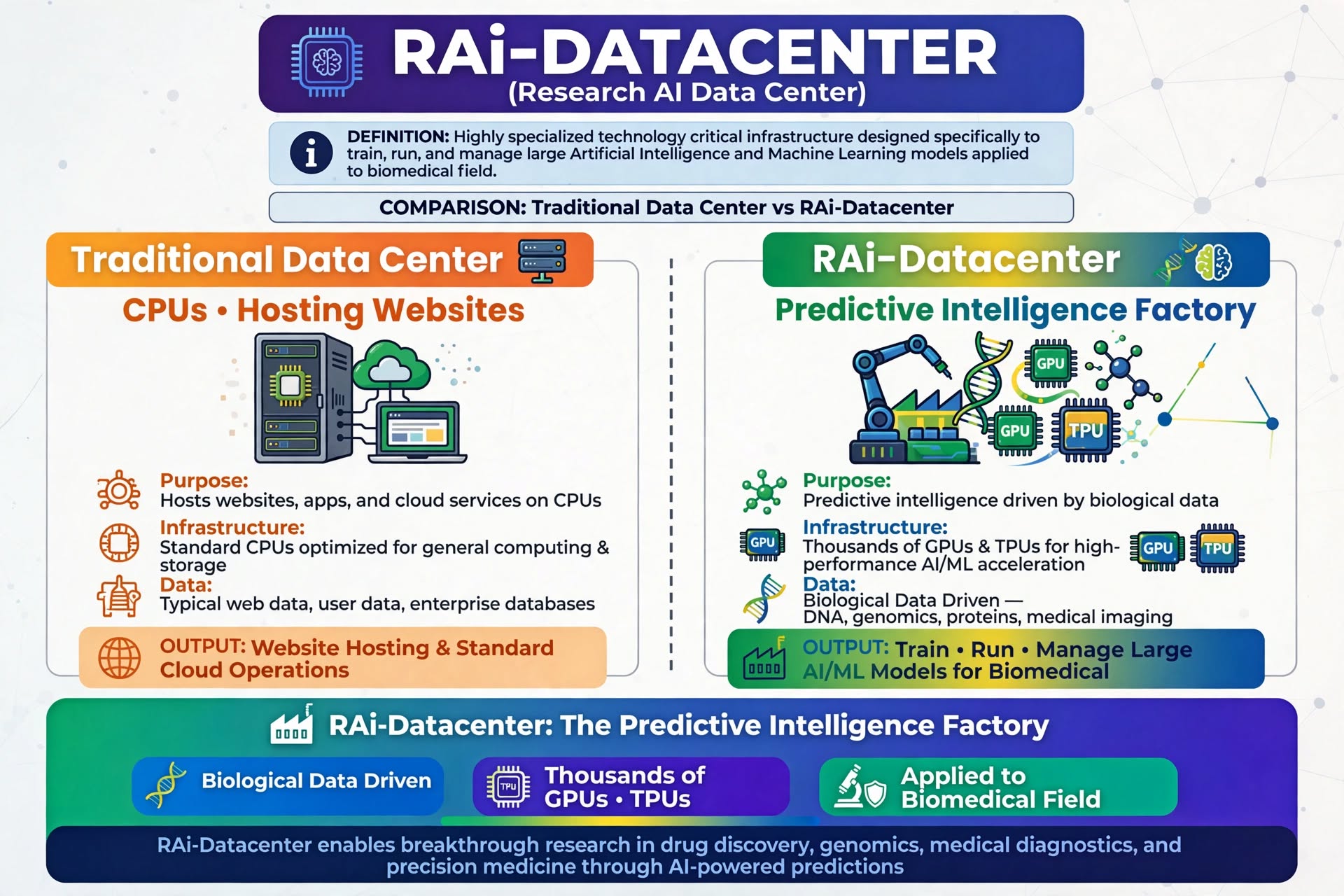
Figure 1: Traditional vs RAI-Datacenter
1. The RAI-Datacenter vs the Challenge of Massive Data in Modern Cancer Research
An RAi-Datacenter (Research AI Data Center) is a highly specialized technology critical infrastructure designed specifically to train, run, and manage large Artificial Intelligence and Machine Learning (ML) models applied to the biomedical (BioMed) field. Unlike a traditional data center, which focuses on hosting websites or corporate systems (running on conventional CPUs), the RAi-Datacenter functions essentially as a “predictive intelligence factory” driven by biological data, structured with thousands of high-performance accelerators (such as GPUs and TPUs).
Modern cancer research does not lack information; instead, it struggles to combine millions of scattered clues. Over the past two decades, advanced testing, DNA profiling, and molecular mapping have generated vast amounts of biological data. However, turning these findings into working medicines remains very slow. More than 90% of new cancer drugs tested in early human trials fail to reach patients, mostly because they turn out to be ineffective against complex human tumors.
This high failure rate happens because biological information is often stored in disconnected places. Genetic changes do not act alone; a single DNA change can cause completely different reactions depending on the cell’s environment and surrounding signals. Traditional research methods—which rely on testing thousands of random chemicals against isolated proteins in test tubes—frequently fail to predict how a target will behave inside a living, evolving tumor.
The V-II-TES-AI Research Database was created to overcome this disconnect. Acting as a central smart hub, it gathers genetic profiles, tissue maps, and 3D protein structures into one connected system. By using advanced computer networks across these biological layers, the platform helps scientists look past simple patterns and directly find tumor weak spots.
The V-II-TES-AI (SI) Research Database emerges as a purpose-built infrastructural intervention designed to resolve this fragmentation. Functioning as a high-performance computational ontology, the system aggregates whole-exome sequencing, longitudinal spatial transcriptomics, and cryo-EM structural datasets into a unified graph architecture. By applying graph neural networks (GNNs) across these interconnected biological strata, the platform transcends standard correlation analysis, enabling researchers to interrogate target vulnerability through the lens of structural systems biology.
Figure 2: Workflow comparison showing how traditional long discovery timelines are shortened using smart computer databases.
2. Finding and Validating Cancer Weaknesses
A common problem in traditional cancer drug design is relying on overly simplified models. Old pipelines usually target a single faulty protein, turn it off in lab cells, and assume the same fix will work across different patients. However, tumors are flexible and often turn on backup pathways to survive once treatment starts.
The new smart database shifts target selection toward mapping entire biological webs. Instead of looking at genes one by one, its predictive algorithms process the tumor’s multi-layered profile as a web of connected proteins. By measuring weak links across patient samples, the database automatically highlights hidden cancer vulnerabilities—parts of proteins that normal cells do not rely on, but that cancer cells desperately need to survive.
In addition, the platform examines dynamic shape changes in proteins. Historically, many key cancer drivers were labeled “undruggable” because they lacked obvious, deep surface pockets for medicines to latch onto. The V-II-TES-AI database simulates moving molecules in 3D, catching temporary openings that appear only for brief moments. This turns target validation from a multi-year lab experiment into a fast, accurate computer simulation.
3. Designing and Refining Custom Medicines
Once a cancer target is confirmed, the next challenge is creating safe, effective drug candidates. Standard chemistry relies on long cycles of making molecules, tweaking them in the lab, and testing them on cells. This search for promising leads usually takes three to five years and costs millions of dollars per program while exploring only a fraction of possible chemical designs.
The smart database speeds up this step by using 3D generative AI models to build new molecules from scratch. Instead of sifting through existing compound collections, the computer builds brand-new molecules right inside the protein’s target pocket, matching physical shapes, electrical charges, and chemical bonds with sub-atomic precision.
Figure 3: The three-step virtual refinement process: target mapping, custom molecule building, and digital safety screening.
To refine drug candidates rapidly, the system uses high-precision physics simulations instead of rough estimations:
- Precise Binding Calculations: Calculates how tightly a drug molecule will lock onto its target protein, matching laboratory test accuracy without needing initial physical synthesis.
- Virtual Safety & Absorption Profiling: Tests compounds across digital models of body absorption, liver breakdown, and potential heart toxicity before any physical chemical is made in a laboratory.
- Off-Target Safety Checks: Screens created molecules against thousands of normal human proteins to spot unintended side effects early, protecting healthy tissues.
By combining physics simulations with creative AI tools, the platform shortens the drug design phase from four years down to a few weeks, yielding treatments designed for high safety and strong potency.
4. Tackling Tumor Diversity and Drug Resistance
The hardest challenge in treating cancer is that tumors are made of many different cell types (tumor heterogeneity) that constantly mutate. A single medication might destroy 95% of a tumor, leaving behind a tiny group of resistant cells that later grow back. The V-II-TES-AI database tackles this problem by directly connecting to real-time genetic sequencing data.
Figure 4: Data pipeline showing how patient gene tests feed into the smart predictive engine.
The platform ingests streaming information from whole-genome sequencing, blood tests, and single-cell gene profiling. By studying genetic changes cell by cell, V-II-TES-AI maps how tumors evolve over time. It projects new mutations onto 3D protein structures, predicting whether a drug will lose its grip before resistant cells spread.
For instance, if a patient’s tumor develops a new mutation that blocks a standard drug, the smart system immediately predicts the physical blockage, calculates the loss in drug strength, and searches for alternative drug shapes that can attach to a different spot on the protein. This bridges the gap between patient genetic testing and personalized care.
5. From Computer Design to Patient Care
The ultimate goal of any medical computing system is to improve patient health and achieve long-term recovery. Moving computer models into real-world medicine requires navigating real biological factors, such as drug delivery barriers, tissue blood flow, and immune system responses.
The platform reduces trial risks through several key features:
- Personalized Cancer Vaccine Design: Analyzes a patient’s immune system markers and tumor mutations to identify unique targets, guiding the creation of custom mRNA cancer vaccines.
- Smart Combination Therapies: Because single drugs rarely cure advanced tumors alone, computer models test drug combinations in simulation to find pairs that attack multiple tumor survival pathways at once without doubling side effects.
- Targeted Biological Vulnerabilities: Identifies unique weaknesses present only in cancer cells, leaving healthy tissues unharmed and reducing patient treatment discomfort.
While computer modeling narrows down the choices dramatically, lab verification remains vital. Cell culture tests and organ models are still used as necessary final checks. However, by acting as a smart initial filter, the database ensures that only high-probability, safe compounds move into laboratory testing.
6. Traditional Methods vs. Smart Database Pipeline
To highlight the key improvements, the table below compares standard drug discovery against the streamlined V-II-TES-AI database process.
| Feature / Metric | Traditional Oncology Research | V-II-TES-AI Guided Pipeline |
|---|---|---|
| Lead Discovery Time | 3 to 5 years of physical lab trials | A few weeks using virtual computer modeling |
| Target Validation Basis | Isolated protein tests and gene knockouts | Full biological web modeling and weak spot detection |
| Drug Effectiveness Testing | Random physical compound library screening | Atomic 3D physics simulations & virtual testing |
| Managing Drug Resistance | Reactive changes after a patient relapses | Proactive prediction of mutations via genetic profiling |
The Strategic Horizon
The movement from trial-and-error discovery to guided digital design marks a major leap forward for cancer medicine. As the V-II-TES-AI Research Database continues to bring together biological and structural data, its predictive tools will make complex protein interactions easier to understand and target.
For doctors, researchers, and healthcare leaders, adopting this modern computing approach is becoming essential. By linking target discovery directly to 3D biological models and real-time gene tracking, cancer treatments can be designed faster, drug resistance can be anticipated early, and patient care can become far more effective.
Conclusion: How V-II-TES-AI Database Engineering Critical Infrastructure Accelerates Cancer Discovery
The implementation of the V-II-TES-AI Database Engineering Critical Infrastructure transforms cancer research from a slow, empirical trial-and-error approach into a fast, predictive digital science. By unifying high-density computing with advanced biological models, the infrastructure accelerates oncology discoveries and improves treatment development across every stage of the research pipeline.
| Discovery & Treatment Stage | Traditional Oncology Research | V-II-TES-AI-Database-Guided Research |
|---|---|---|
| 1. Target Identification & Mapping | Relies on static protein models and simple gene knockouts; misses complex tumor interactions. | Maps interconnected protein networks using AI graph tools to expose hidden, dynamic target pockets instantly. |
| 2. Molecule Creation & Lead Optimization | Takes 3–5 years testing thousands of physical compounds in wet-lab assays. | Generates custom molecules digitally in weeks using 3D structural AI and quantum physics simulations. |
| 3. Safety & Side-Effect Screening | Evaluates drug toxicity late in animal models, leading to high failure rates in human clinical trials. | Screens drug candidates virtually against whole-body protein arrays to catch side effects before physical synthesis. |
| 4. Overcoming Resistance & Heterogeneity | Reacts after tumor mutations cause treatment failure and clinical relapse. | Feeds real-time patient sequencing into computer models to predict resistant mutations and design backup drugs in advance. |
| 5. Clinical Translation & Patient Outcomes | Uses standard one-size-fits-all drug regimens with broad side effects and variable patient success. | Enables personalized cancer vaccines, tailored combination therapies, and precise target selectivity for lasting remission. |
References
- Jumper, J., Evans, R., Pritzel, A., Green, T., Figurnov, M., Ronneberger, O., … & Hassabis, D. (2021). Highly accurate protein structure prediction with AlphaFold. Nature, 596(7873), 583-589. https://doi.org/10.1038/s41586-021-03819-2
- Korsunsky, I., Millard, N., Fan, J., Slowikowski, K., Zhang, F., Wei, K., … & Raychaudhuri, S. (2019). Fast, sensitive and flexible integration of single-cell data with Harmony. Nature Methods, 16(12), 1289-1296. https://doi.org/10.1038/s41592-019-0619-0
- Wang, L., Wu, Y., Deng, Y., Kim, B., Pierce, L., Krilov, G., … & Abel, R. (2015). Accurate and reliable prediction of relative ligand binding free energies in prospective drug design using a modern scoring approach and free energy perturbation. Journal of the American Chemical Society, 137(7), 2695-2703. https://doi.org/10.1021/ja512751q
- Bailey, M. H., Tokheim, C., Porta-Pardo, E., Sengupta, S., Bertrand, D., Weerasinghe, A., … & Ding, L. (2018). Comprehensive characterization of cancer driver genes and mutations. Cell, 173(2), 371-385. https://doi.org/10.1016/j.cell.2018.02.060
- Vamathevan, J., Clark, D., Czodrowski, P., Dunham, I., Ferran, E., Lee, G., … & Zhao, S. (2019). Applications of machine learning in drug discovery and development. Nature Reviews Drug Discovery, 18(6), 463-477. https://doi.org/10.1038/s41573-019-0024-5