
Transforming 2.4 Billion Unprocessed Reads into Oncological Molecules—in Weeks, Not Decades
Coordinated by
**Prof. Aecio D’Silva, Ph.D.**
Abstract. Global exome repositories contain millions of genetic variants capable of unlocking groundbreaking cancer cures, yet they remain inaccessible due to computational bottlenecks. Deploying an AI Datacenter for Research (RAI-DC) provides the exaflop-scale computing power needed to rapidly process, analyze, design, simulate, and validate molecules. In Brazil—where delays in diagnosis and treatment cost lives daily—V-II-TES-RAI-DC infrastructure is a national imperative to accelerate patient care and transform precision oncology.
The Calamity: A Vault of Hundreds of Millions of Uninterpreted Variants
Massive genomic initiatives—such as the Mayo Clinic’s Tapestry study (which sequenced over 100,000 exomes and generated 1.1 million datasets), alongside gnomAD, ClinVar, and the UK Biobank’s 500,000 exomes—have amassed more than 800 million genetic variants. However, interpreting whole-exome data at scale remains an immense challenge. Analyzing a single genome generates terabytes of data, and virtual screening against a billion drug compounds requires exaflop-scale computing. Traditional High-Performance Computing (HPC) clusters often take months to process queries that a specialized V-II-TES-RAI-DC can pre-compute in hours, as demonstrated by DeepMind’s AlphaGenome Atlas in mapping 9 billion variants.
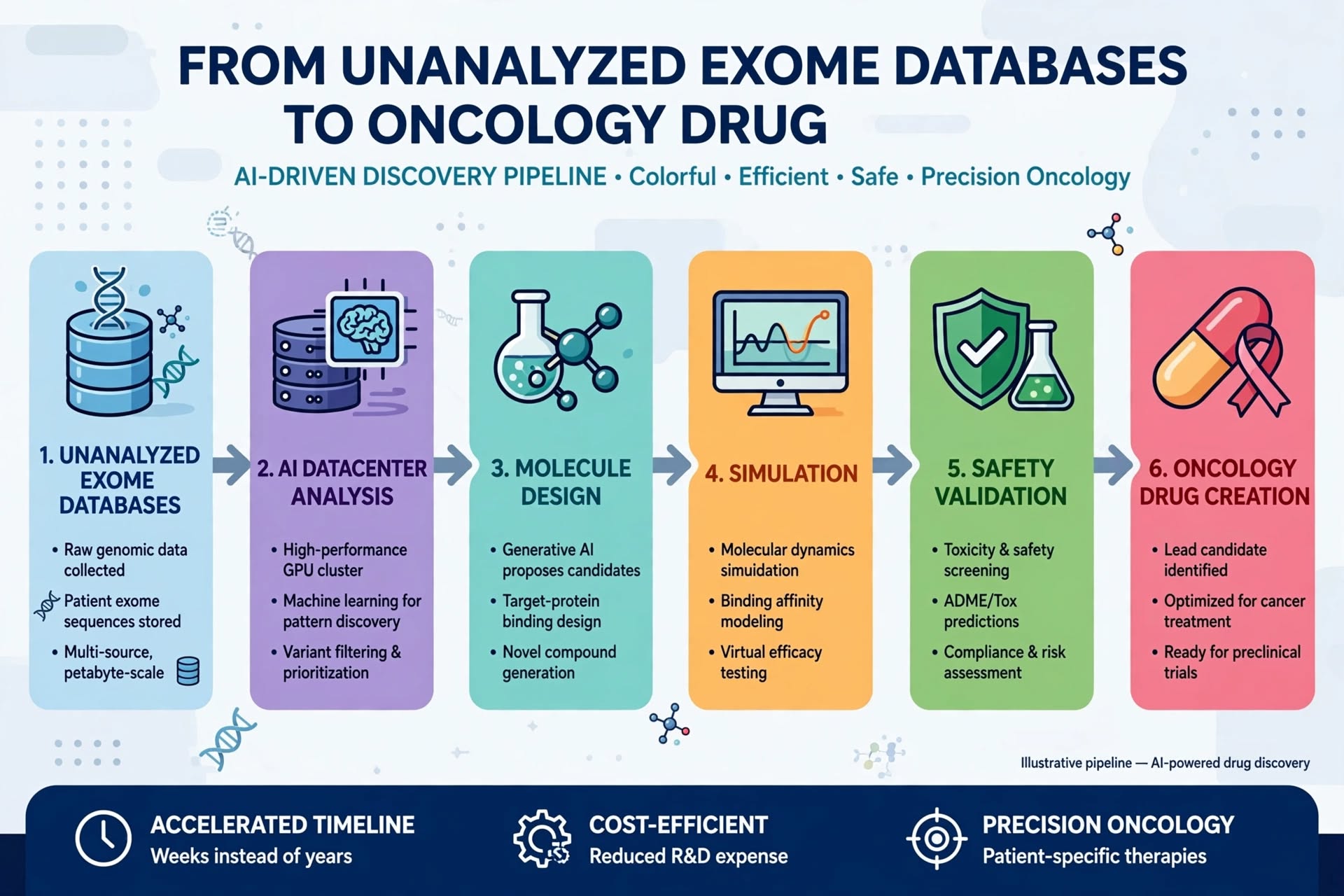
How a Research AI Data Center Solves the Problem: The 5-Stage Pipeline
Processing: Parallel alignment of 1,000 genomes/day using GPU-accelerated pipelines.
Analysis: Transformer models prioritize pathogenic variants using explainable AI for rare diseases.
Design: Generative AI creates new molecules optimized for binding affinity, low toxicity, and ADMET properties.
Simulation: Quantum-accurate molecular dynamics and large-scale protein-ligand docking.
Validation and Safety: Continuous testing against experimental data and traceable workflows to predict toxicity prior to synthesis.
From Data to Drug: Saving Lives in Real Time
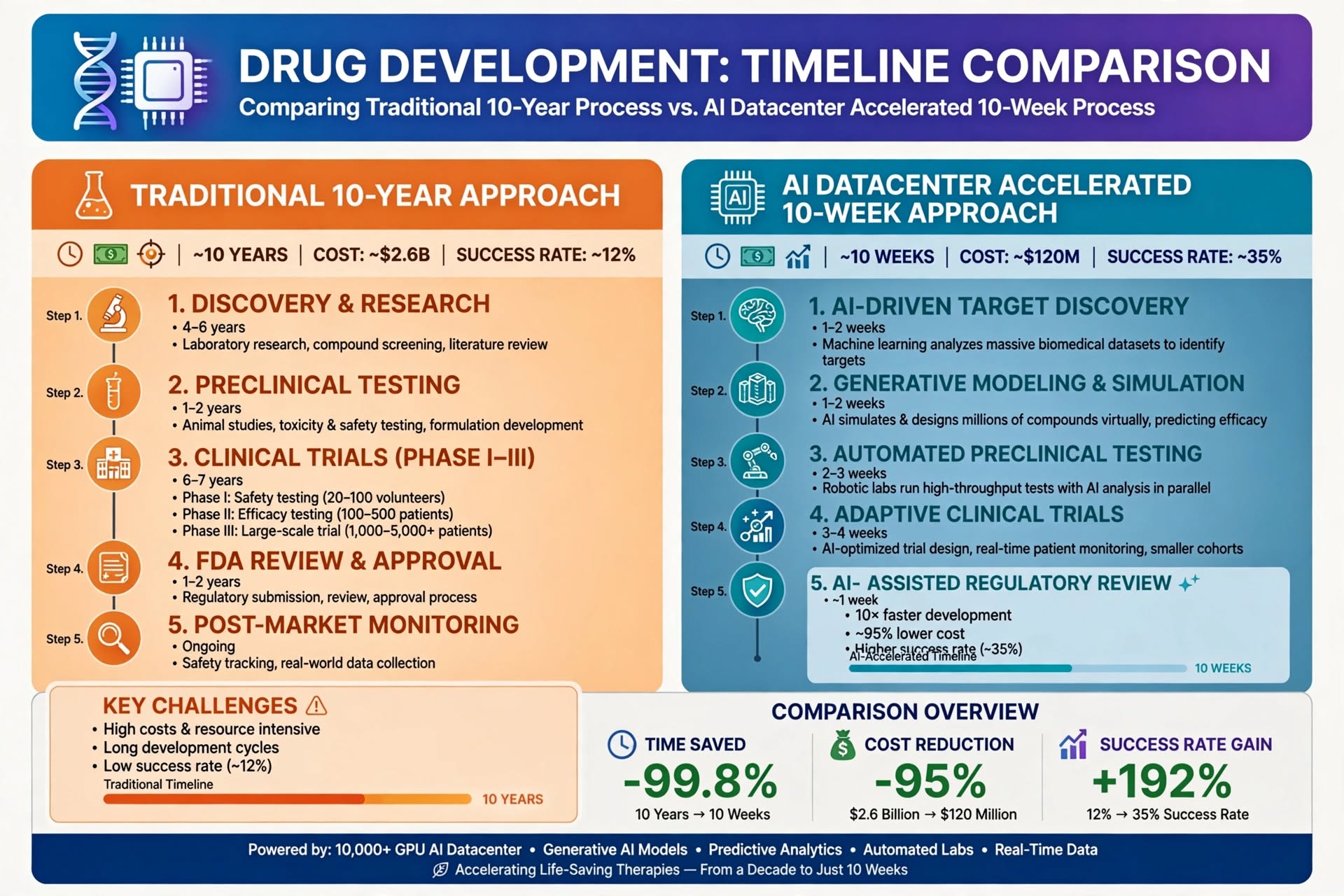
In silico drug design using generative AI models has already produced novel mTOR inhibitors that outperform traditional therapies. By centralizing exaflop-scale computing, a Research AI Data Center reduces the traditional drug discovery cycle—spanning 10 years and costing $2.6 billion—to approximately 10 weeks and $120 million, while increasing success rates from 12% to 35%. For critically ill patients, this time reduction translates directly into lives saved.

Brazil: A National Emergency That the RAI-DC Can Transform to Save Lives
The Unified Health System (SUS) serves more than 75% of Brazil’s 215 million citizens. However, structural bottlenecks present an urgent crisis: studies show that 40% of cancer patients wait more than 60 days to begin treatment. Less than 18% start radiotherapy within 30 days of diagnosis, compared to 100% in countries like Canada. According to a Harvard report, Brazil faces a cancer incidence rate of 215.4 cases per 100,000 inhabitants and the second-highest mortality rate in Latin America (91.2 per 100,000). The approval process for immunotherapies often takes 180 days or more—time enough for the disease to become fatal.
Creating a Brazilian AI-enabled data center (RAI-DC) integrated with the SUS, INCA, and regional cancer centers (CACONs) offers an unprecedented opportunity to save lives. Specifically, the RAI-DC will enable:
1. Analyzing Local Exome Diversity: Mapping Brazilian genetic variants that are underrepresented in global databases.
2. Designing Targeted Therapies: Rapidly synthesizing and optimizing molecules relevant to the local population.
3. Optimizing Adaptive Clinical Trials: Connecting patients to targeted trials using precision diagnostic tools.
4. Reducing Delivery Delays: Cutting the time between drug approval and delivery from 180 days to 14 days.
Conclusion: Computing Is Healthcare
We do not lack biological data or scientific capacity; we lack the processing power needed to decode them in time. Investing in AI data centers dedicated to research is a humanitarian imperative. By deploying exaflop-scale computing in Brazil, we can unlock genomic data and deliver cancer cures at the speed patients need.
Call to Action: Join the Global Movement for Precision Health
The transition from genomic data to life-saving treatments requires collective action among research institutions, health policymakers, and technology partners. Support the initiative to establish the RAI-Datacenter infrastructure dedicated to research in Brazil today. Contact us to collaborate, sponsor exaflop-scale computing allocation, or integrate public health data.
Glossary of Key Terms.
Exome: The fraction of the genome formed by exons, containing the instructions for protein synthesis.
Exaflop Scale: Computational capacity capable of performing at least one quintillion (10^18) calculations per second.
ADMET: Absorption, Distribution, Metabolism, Excretion, and Toxicity properties of a drug.
Oncological molecules:
What they are:
Chemical compounds, genetic fragments, or cancer drugs designed within the RAI-DC to interact with specific biological targets in cancer cells, interfering with their growth, metabolism, or reproduction.
How they work:
Specific target: Unlike traditional chemotherapy, which affects all rapidly dividing cells, oncological molecules (such as those used in molecular targeted therapy) aim to block proteins, enzymes, or mutated genes unique to the tumor.
Main types:
Include monoclonal antibodies, tyrosine kinase inhibitors, and novel synthetic molecules that disrupt metabolism or cut off the cancer’s energy supply.
Biomarkers: Also encompass biological molecules found in blood or tissues (such as circulating tumor DNA or exRNAs) used for early screening and disease monitoring. Precision Oncology: Molecular tumor mapping to identify specific genetic targets and personalized treatments.
Molecular targeted therapy: An oncology treatment that uses drugs—such as targeted molecules—to identify and block specific genetic alterations, proteins, or signaling pathways that cause cancer cells to grow and multiply.
V-II-TES-RAI-DC – AI Data Centers Dedicated Exclusively to Research
Pathogenic Variant: A genetic alteration that increases susceptibility to developing a disease:
References:
1 – Mayo Clinic Tapestry: Largest-ever exome study, 100k participants, 1.1M datasets – ScienceDaily 2024
2 – AlphaGenome Atlas: 9B variants precomputed, reducing months of HPC time to simple queries – DeepMind 2025
3 – Tyrone Systems: Precision Computation – terabytes per single genome, exaflops for billion-compound analysis
4 – Harvard T.H. Chan: Addressing the rising cancer burden in Brazil – 215.4/100k incidence rate
5 – The Lancet: Practical considerations for expediting breast cancer treatment in Brazil – 40% experienced delays >60 days; 51% treated within 60 days
In Belo Jardim, student of the Grupo Escolar Bento Américo and Prof. Donino Gymnasium, and student of the teachers: Dulce Ramos, Alba Leite, Dona Conceição Moura, Dona Olindina Mergulhão, Estefânia Moura Bezerra, and Maria Luiza