Contents
- 1. AI turning faster diagnoses into saved childhoods — and why excellence must become a system, not a slogan
- 2. Prof. Aecio D’Silva, PhD · BioMed AI & Critical Thinking SUSTAINABLE TECHNOLOGIES
- 3. The week that changed the conversation
- 4.
- 5. From genomes to decisions
- 6. The St. Jude lesson
- 7. What excellence really means
- 8. The operating model
- 9. What you can do Now
- 10. Conclusion
- 11. Conclusion
- 12. References (APA)
AI turning faster diagnoses into saved childhoods — and why excellence must become a system, not a slogan
Coordenated by
Prof. Aecio D’Silva, PhD ·
BioMed AI & Critical Thinking
SUSTAINABLE TECHNOLOGIES
Summary: BioMed AI is turning genomic data into faster pediatric cancer diagnoses, while Total Excellence Management Systems turn good practice into repeatable, governed quality.
Hero image
The week that changed the conversation
This week, The Hospital for Sick Children (SickKids) and Microsoft Canada announced a five-year strategic partnership to advance AI-powered pediatric care. Leaders had visited SickKids on October 15, but the announcement mattered more than the visit. It formalized a shared bet: connected data, cloud security, and AI-enabled innovation can help teams diagnose faster, treat smarter, and predict better. That phrase — diagnose faster, treat smarter, predict better — is not marketing. In pediatric oncology, time is biology. A tumor that is classified correctly in days rather than weeks changes which therapy a child receives, which trial they can enter, and how a family plans its life. The partnership builds on years of investment in cloud infrastructure, and it aims to strengthen the digital foundation for Precision Child Health, the idea that care should be tailored to each child’s genome, history, and risk, not averaged across adults.
From genomes to decisions
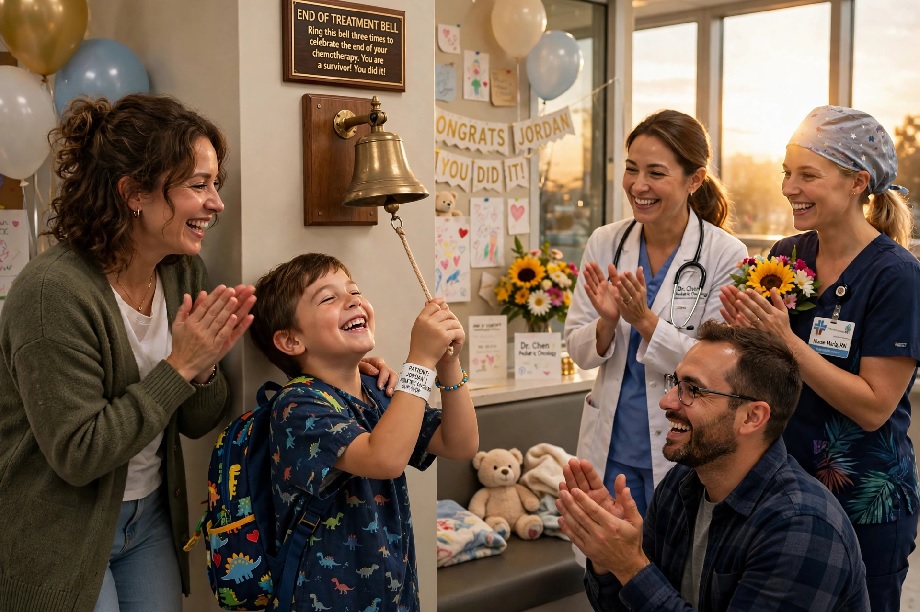
The week other great news is: Illumina debuted BioInsight, its first unified software environment for turning complex genomic and multiomic data into meaningful biological evidence. Some time ago, it expanded the platform with early-access tools including Workflow Orchestrator, DRAGEN Ultra, and Learning Cohorts. Its BioInsight AI Lab also introduced SpliceAI2, which Illumina said identified 17% more disease-relevant variants than other splicing models in a rare-disease dataset. Why does this matter for a child with cancer? Because pediatric cancers are often driven by rare, specific genetic changes. Finding the right variant is not a footnote; it is the diagnosis. A model that surfaces a splice variant other tools miss can be the difference between an uncertain case and a targeted plan.
The St. Jude lesson
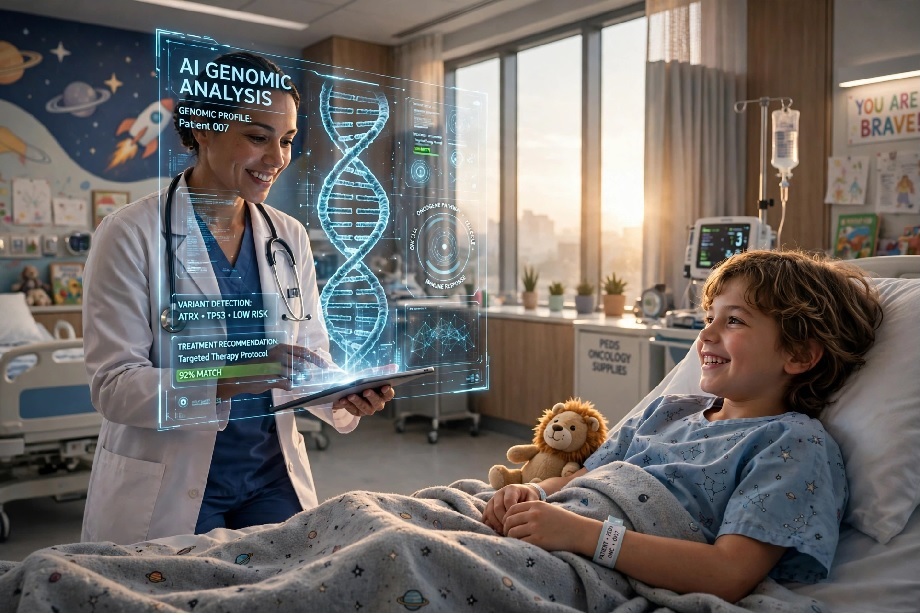
This week, St. Jude Children’s Research Hospital scientists reported a potential vulnerability in aggressive osteosarcoma, a pediatric bone cancer, where a combination approach slowed tumor growth and prolonged survival in preclinical models. The same week, St. Jude researchers identified neuroblastoma cells that signal poor outcomes, building one of the most comprehensive datasets of those cells to date. These are not AI stories in isolation. They are data stories. Large, curated datasets — cell by cell, variant by variant — are what allow AI to learn patterns no single clinician could see. When a hospital can compare a child’s tumor to thousands of others, the question shifts from ‘what is this?’ to ‘what has worked for children like this?’ That shift is the core promise of BioMed AI.

What excellence really means
The second subject of this post is less visible but just as urgent: AI in Total Excellence Management Systems. Excellence cannot live in a single expert’s head. If a great diagnosis depends on one person being on shift, it is not a system. A Total Excellence Management System captures knowledge, standardizes successful execution, connects performance to decisions, and learns from every case. In 2026, reports from Smartsheet and others warn of a gap: operations teams are moving faster than their systems, and 70% of operations professionals are using unsanctioned ‘shadow AI’ to keep up. That is a signal, not a scandal. People will use AI where it helps. The job of leadership is to bring that energy into a governed, secure, auditable system — so that excellence is repeatable, safe, and measurable.
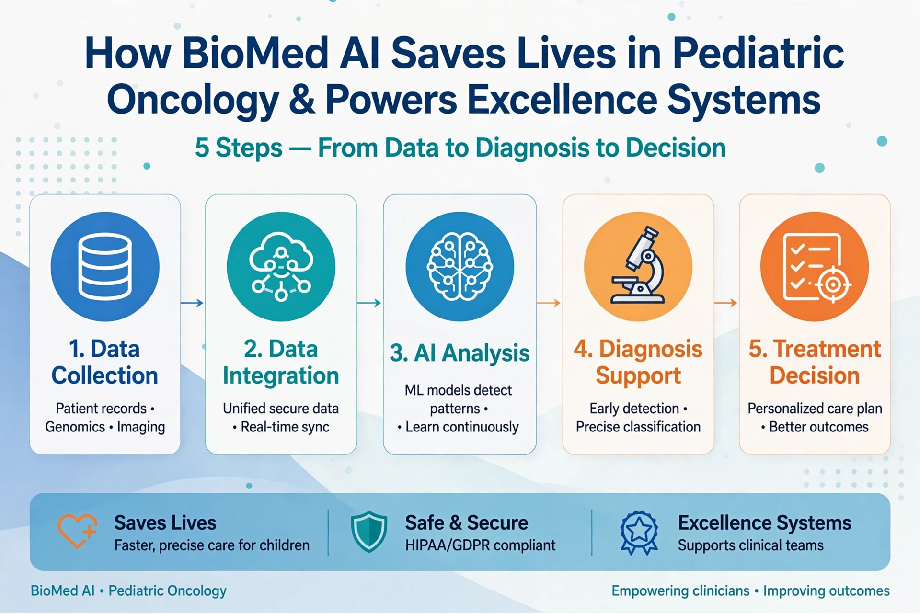
The operating model
A practical model has five moves. First, connect data: genomics, clinical records, imaging, and operational data in one trusted place, with privacy and security designed in. Second, standardize decisions: define what a good diagnosis, handoff, and review looks like, and let AI check for gaps. Third, learn continuously: feed outcomes back into the model, so next month’s system is smarter than this month’s. Fourth, govern AI: track which tool was used, for whom, and why, and audit it. Fifth, develop people: train staff not just to use AI, but to question it, explain it to families, and know when to override it. SickKids and Microsoft explicitly include staff training in their partnership — a reminder that the best system is human plus machine.
What you can do Now
If you lead a clinic, school, company, or community project, start small and start documented. Pick one high-impact process — triage, referral, or follow-up — and map it end to end. Measure time-to-decision and error rate today. Add one AI check with a human in the loop, and review results weekly. Share a one-page summary with your team in plain language. Excellence grows when it is visible. For families, ask your care team: ‘Is my child’s data being compared to similar cases? What genomic testing is available? How will we know if the plan is working?’ Those questions are not confrontational; they are the questions a good system is built to answer.
Conclusion
These two stories meet. In a children’s hospital, AI is helping turn a genome into a plan, and a plan into a childhood preserved. In an organization, AI is helping turn a good practice into a repeatable system, so that quality does not depend on luck. Both stories share the same discipline: connect data, protect trust, standardize what works, and keep people at the center. That is BioMed AI. That is total excellence. And that is why these two matters.
Conclusion
References (APA)
- Hospital for Sick Children. (2026, October 20). SickKids and Microsoft Canada join together to help teams diagnose faster, treat smarter and predict better. SickKids. https://www.sickkids.ca
- Illumina. (2026, October 14). Illumina launches BioInsight Platform, its first unified software environment to help accelerate genomic and multiomic breakthroughs. PR Newswire.
- Illumina. (2026, October 8). Illumina launches SpliceAI2 model for splice variant interpretation. Unite.AI.
- St. Jude Children’s Research Hospital. (2026, October 20). Combination therapy reveals potential vulnerability in aggressive osteosarcoma. St. Jude.
- Smartsheet. (2026). 2026 operational excellence report: 70% of operations management professionals use shadow AI. Business Wire.