Pensamento Lógico e Pensamento Criativo

Using Total Excellence Management Systems (TES): Practical Sprint Techniques to Unlock Your Brain’s Exponential Creative Potential


Coordinated by
Prof. Aecio D’Silva, PhD
Moura Enterprises Critical Thinking
SUSTAINABLE TECHNOLOGIES

SprintBrain
Figure 1: Channeling raw neural energy through structured Total Excellence Management Systems (TES) sprint grids accelerates creative synthesis

Creativity is frequently misunderstood as an unpredictable spark that strikes only in the absence of rules. In reality, cognitive science and operational excellence research demonstrate the opposite: unstructured freedom often induces decision paralysis and attentional fatigue. Total Excellence Management Systems (TES)—a disciplined methodology rooted in continuous improvement, visual workflow management, and waste elimination—provides the exact architectural scaffolding the human brain needs to innovate at scale. By adapting TES principles into time-boxed creative sprint techniques, individuals and teams can separate divergent exploration from convergent judgment, reduce extraneous cognitive load, and build a repeatable engine for exponential creative output. This guide unpacks the neuroscience behind structured sprints, presents a step-by-step four-phase TES Sprint Cycle, illustrates real-world applications across writing, design, and strategy, and provides actionable protocols to implement immediately.

Keywords: Total Excellence Management Systems (TES), creative sprint techniques, exponential creative potential, cognitive load, divergent thinking, operational excellence.

1. Introduction: Why Unstructured Brainstorming Fails the Modern Brain

Walk into a traditional brainstorming session or sit down to tackle an open-ended creative project without boundaries, and you will likely encounter a familiar bottleneck: the blank-page freeze. When every option is on the table and no time boundary exists, the brain’s prefrontal cortex burns massive metabolic energy simply deciding where to start and how to evaluate ideas prematurely.

Modern knowledge workers face relentless context switching, notification fragmentation, and vague objectives. Trying to solve complex creative problems through marathon, unpaced effort leads to diminishing returns. Total Excellence Management Systems (TES)—traditionally applied to optimize manufacturing, quality assurance, and enterprise operations—offers a counterintuitive solution. Rather than stifling imagination, TES eliminates process friction, clarifies quality standards upfront, and channels human ingenuity into short, high-intensity bursts of focused execution.

2. The Neuroscience of Structured Constraints and TES

To understand why TES unlocks exponential creativity, we must examine how the brain generates novel ideas. Breakthrough thinking requires dynamic switching between two large-scale neural networks:

  1. The Default Mode Network (DMN): Responsible for associative thinking, daydreaming, memory retrieval, and connecting disparate concepts.

  2. The Executive Control Network (ECN): Responsible for focused attention, critical evaluation, working memory management, and goal-directed execution.

When people try to generate ideas and critique them simultaneously, these two networks interfere with one another. Cognitive Load Theory shows that working memory has a strictly limited capacity; when cluttered by self-censorship and unclear criteria, creative fluency collapses.

SprintBrain
Figure 2: Unstructured ideation creates cognitive friction, whereas TES sprint architecture builds clean pathways from raw concept to execution.

TES resolves this neural bottleneck through three core operational mechanisms:

  • Muda (Waste) Elimination: TES removes non-value-adding mental overhead—such as formatting debates, perfectionism during rough drafts, and ambiguous goals—freeing working memory for pure ideation.

  • Standardized Work Cadence: Time-boxed intervals signal the brain exactly which neural mode to engage, preventing premature self-editing.

  • Kaizen (Continuous Rapid Iteration): Instead of betting everything on one massive, high-pressure reveal, TES favors rapid micro-prototypes that compound in quality across successive cycles.

3. The Four-Phase TES Creative Sprint Cycle

Applying TES to creative work does not require complex enterprise software. At its core is a repeatable, 90-minute TES Creative Sprint Cycle divided into four distinct, time-boxed stages.

SprintBrain
Figure 3: The four-phase TES Creative Sprint Loop balances expansive divergent thinking with disciplined convergent evaluation.

Phase 1: Calibrate (10 Minutes) — Define the “Definition of Done”

In TES, excellence begins with clarity. Before generating a single idea, define the exact problem boundary, target audience, and success criteria.

  • Action Step: Write a single-sentence Sprint Charter (e.g., “Generate 15 distinct angles for our Q3 product launch email that address customer onboarding friction”).

  • Rule: Zero ideation happens here—only constraint setting.

Phase 2: Diverge (30 Minutes) — High-Velocity Volume Generation

With boundaries locked, turn off the inner critic and maximize associative fluency. Engage the Default Mode Network at full speed.

  • Action Step: Set a visible timer for 30 minutes. Produce raw concepts, headlines, sketches, or code snippets continuously without deleting, backspacing, or judging quality.

  • Rule: Quantity drives quality. Aim for a specific numerical quota (e.g., 20 raw concepts in 30 minutes) to push past obvious, cliché first thoughts.

Phase 3: Converge (25 Minutes) — TES Quality Filtering

Now activate the Executive Control Network. Apply objective TES evaluation criteria—such as feasibility, novelty, and user impact—to filter your raw pool.

  • Action Step: Score each concept rapidly on a simple 1–3 scale against your Sprint Charter. Group complementary fragments into 2 or 3 high-potential “champion” concepts.

  • Rule: Be ruthless with ideas, gentle with yourself. Discarded ideas are not failures; they are essential stepping stones that cleared the path to the winners.

Phase 4: Synthesize & Prototype (25 Minutes) — Tangible Output Creation

An idea has zero operational value until it takes tangible form. Use the final block to build a minimum viable artifact.

  • Action Step: Draft the complete outline, build the wireframe, record the rough demo, or write the core narrative of your top selected concept. End with a 3-minute retrospective note on what worked in the sprint.

4. Traditional Marathon Work vs. TES Creative Sprints

Operational Dimension Traditional Unpaced Brainstorming TES Creative Sprint Architecture
Cognitive Mode Simultaneous generation and critique (high interference) Strictly separated divergent and convergent phases
Time Horizon Open-ended (“work until it’s done”) Fixed micro-intervals (e.g., 90-minute total sprint)
Primary Bottleneck Perfectionism, blank-page anxiety, decision fatigue Managed via upfront constraints and volume quotas
Feedback Loop Delayed until final review Built-in rapid iteration and end-of-sprint synthesis
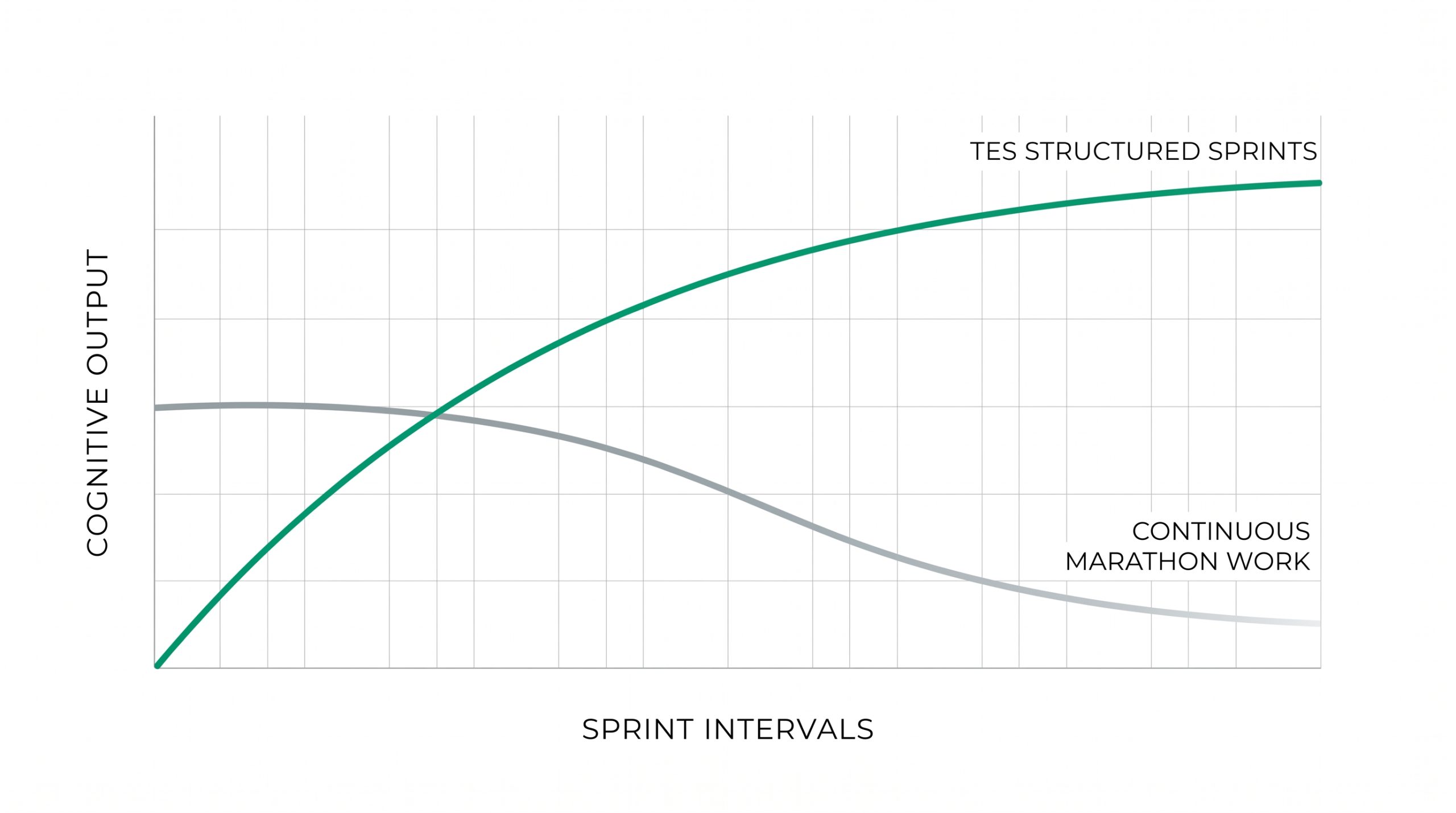
Energy Sustainability Steep decline after 60–90 minutes High cognitive stamina across multiple cycles
SprintBrain
Figure 4: Time-boxed TES sprints prevent attentional fatigue and sustain high creative output compared to unpaced marathon sessions.

5. Practical Applications: Real-World Examples You Can Apply Today

  • Content Writing & Thought Leadership: Instead of staring at a blinking cursor for three hours to write an article, run a 10-minute Calibrate phase to lock your thesis and reader takeaway. Spend 30 minutes in Diverge dictating messy, unedited paragraphs via voice-to-text. Use Converge to arrange the strongest blocks into a logical spine, and Synthesize to polish transitions. Writers routinely cut drafting time by 40% while elevating originality.

  • Product Design & UX Problem Solving: When a user onboarding flow stalls, gather a cross-functional trio for one 90-minute TES sprint. Spend 30 minutes sketching 8 rapid interface variations per person (“Crazy 8s” adapted to TES quality metrics), converge via dot-voting on friction reduction, and spend the final 25 minutes building a clickable low-fidelity wireframe ready for user testing that same afternoon.

  • Strategic Business Planning: Executives facing market shifts can replace sprawling two-day offsites with three back-to-back TES sprints: Sprint 1 maps threat scenarios, Sprint 2 generates asymmetric strategic responses, and Sprint 3 synthesizes a 90-day operational pilot roadmap.

SprintBrain
Figure 5: Visual management boards and dedicated time-boxing tools anchor TES sprint habits in everyday creative environments.

6. Strategic Discussion: Avoiding Common Implementation Traps

While TES sprint techniques yield dramatic gains, teams must navigate three operational trade-offs:

  1. Over-Constraining the Charter: If Phase 1 constraints are too narrow (e.g., dictating the exact solution before exploring), Diverge becomes mechanical box-checking. Define the problem tightly, but leave the solution space wide open.

  2. Skipping the Recovery Buffer: High-intensity sprints demand genuine cognitive recovery. Always enforce a 15-to-20-minute screen-free break between consecutive sprints so the Default Mode Network can consolidate background connections.

  3. Confusing Speed with Rushing: TES sprints are brisk, not frantic. Speed comes from removing distractions and hesitation, not from sacrificing thoughtful evaluation during Phase 3.

7. Conclusion & Actionable Next Steps

Exponential creativity is rarely the result of waiting for lightning to strike; it is the compound return of a disciplined system. By integrating Total Excellence Management Systems (TES) into your creative workflow, you replace exhausting, unstructured guesswork with a reliable cadence that honors how the human brain actually thinks.

Start your first TES Creative Sprint today:

  1. Pick one stalled creative project on your desk right now.

  2. Set a timer for 10 minutes and write a crystal-clear Sprint Charter.

  3. Turn off all notifications, set a 30-minute timer, and generate at least 15 raw ideas without stopping to edit.

  4. Spend 25 minutes selecting your top winner and 25 minutes building a tangible first draft.

8. Verified References

  1. Amabile, T. M., & Pratt, M. G. (2016). The dynamic componential model of creativity and innovation in organizations: Making progress, making meaning. Research in Organizational Behavior, 36, 157–183. https://doi.org/10.1016/j.riob.2016.10.001

  2. Beaty, R. E., Benedek, M., Silvia, P. J., & Schacter, D. L. (2016). Creative cognition and brain network dynamics. Trends in Cognitive Sciences, 20(2), 87–95. https://doi.org/10.1016/j.tics.2015.10.004

  3. D’Silva, Aecio. 2026. Artificial Intelligence and Total Excellence Management Systems (TES).  https://algaeforbiofuels.com/artificial-intelligence-and-total-excellence-management/
  4. Knapp, J., Zeratsky, J., & Kowitz, B. (2016). Sprint: How to Solve Big Problems and Test New Ideas in Just Five Days. Simon & Schuster.

  5. Liker, J. K. (2020). The Toyota Way: 14 Management Principles from the World’s Greatest Manufacturer (2nd ed.). McGraw-Hill Education.

  6. Sweller, J., van Merriënboer, J. J. G., & Paas, F. (2019). Cognitive architecture and instructional design: 20 years later. Educational Psychology Review, 31(2), 261–292. https://doi.org/10.1007/s10648-019-09465-5

Leave a Reply

Your email address will not be published. Required fields are marked *